
 Download PDF
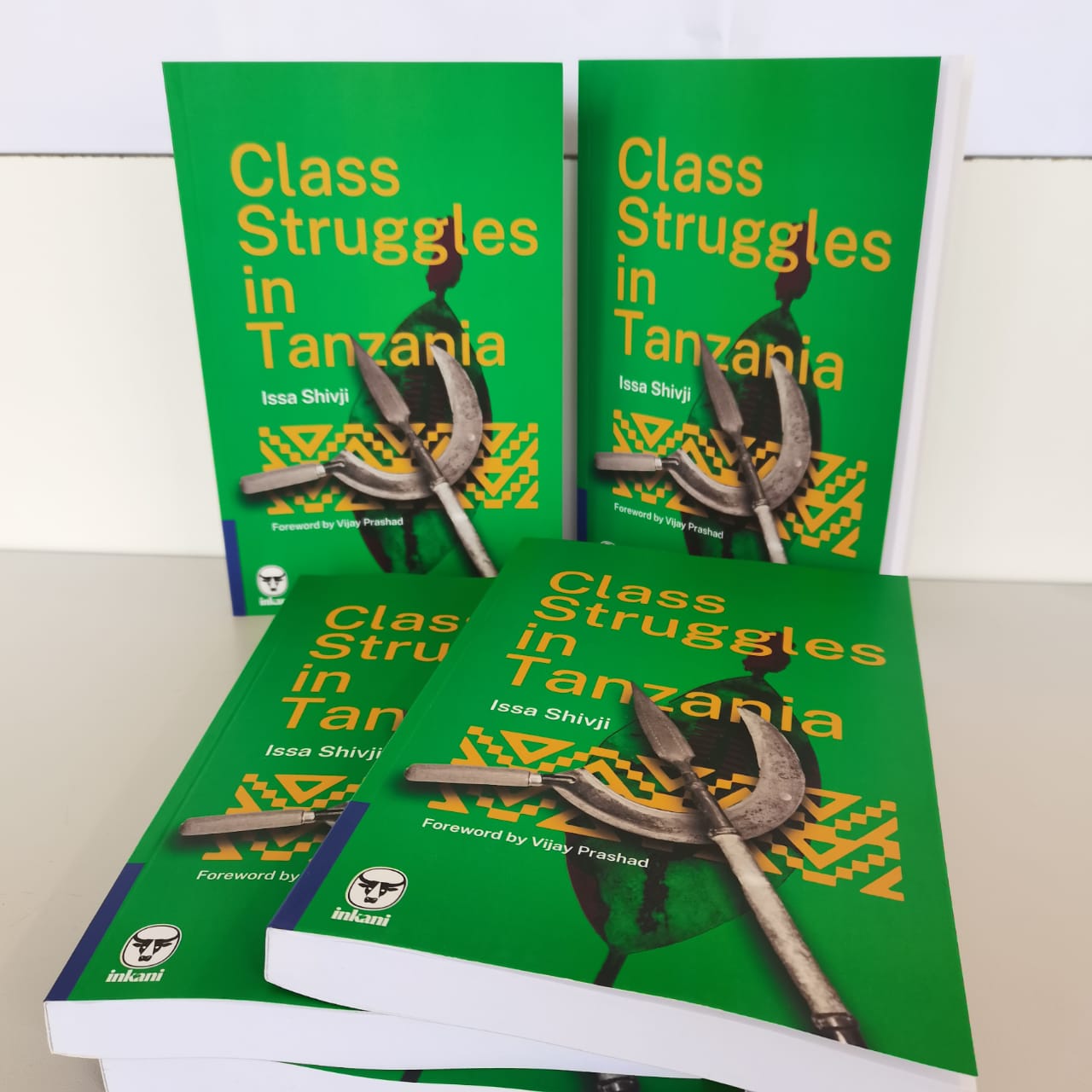
On 31 October 2025, Professor Issa G. Shivji, one of Africa’s most distinguished intellectuals relaunched his classic book, Class Struggles in Tanzania – 50th Anniversary edition with a new introduction. The event reflected his intellectual ideas, which have shaped African thought over the years and shows the relevance of class struggles in Tanzania and South Africa.
Comrade Maria van Driel, the Director of Khanya College, was the session moderator. Van Driel opened the discussion by introducing Professor Shivji’s long and influential body of work. In her remarks, Van Driel offered a deeply personal reflection on how Shivji’s writing, particularly the book Class Struggles in Tanzania, helped them as working class university students.
“When we were in the University of Cape Town, we found ourselves alienated. We came from working class schools, coming across the book Class Struggles in Tanzania was a powerful encounter, a book written by a person of colour who spoke to our realities. We immediately felt an affinity,” explained the Khanya Director.
Van Driel described how, upon reading the book again, its depth and methodological clarity became even more striking. “Reading it again, many things became clearer,” the Khanya Director said. “It’s an important work not only because of its political content but also because of its methodology, its demand that we must interrogate the social determinants at play in every conjuncture.”
The Khanya Director’s reflections connected the book’s enduring relevance to the current moment, emphasising that the relaunch of this text is timely, particularly as Tanzania witnesses a new wave of activism led by Generation Z, including recent strikes and protests.
Van Driel noted that Class Struggles in Tanzania was written by a young Shivji during a period of deep political ferment in Tanzania. It emerged out of a collective intellectual process. It was grounded in study groups and progressive movements that sought to analyse Tanzania’s post-independence trajectory under President Julius Nyerere’s policy of Ujamaa (African socialism).
Van Driel continued to say, the book reflects a generation that believed sincerely in building socialism and self-reliance, even as they critically engaged with the contradictions. Professor Shivji’s adherence to Marxist methodology and the pursuit of this analysis to its logical conclusion, no matter how uncomfortable it is. This remains one of Shivji’s defining intellectual qualities, and its power lies in its methodology and in interrogating every aspect of society, every determinant of social reality, in its specific historical context.
Van Driel reminded the audience that the reissuing of such a classic book means that we must continue to question, to analyse, and to act just as Shivji did when he first wrote it. The challenge remains, facing older comrades and new comrades, how are we assisting in reading with the study groups, given the education system in South Africa.
Comrade Nosipho Mdletshe and Khanya Board member Mondli Hlatshwayo also shared reflections after reading the book. Mdletshe drew parallels between the experiences of the study group, which met weekly, and the themes in Professor Shivji’s book. She expressed appreciation for Professor Shivji’s contribution, saying that his book offers a powerful and honest reflection on Tanzania’s journey after independence.
The study group highlighted the continuity of colonial economic structures in Tanzania as key. Instead of dismantling these systems after independence, the post-colonial state continued to operate within the same frameworks. This allowed participants to draw strong parallels between Tanzania’s struggle and the South African context. In both countries, political liberation did not translate into economic liberation. South Africa achieved political freedom in 1994, yet economic power remains in the hands of the few elites while the majority continue to live in poverty.
The group also engaged deeply with the book’s analysis of class struggles among workers, peasants, and the petty bourgeoisie. They noted that the ongoing economic injustices in Tanzania such as a lack of access to land and inequality. This resonates with South Africa’s own realities. Movements like Marikana and #FeesMustFall reflect these unresolved issues of economic exclusion and inequality.
Mdletshe emphasised another critical point made by Professor Shivji: in both Tanzania and South Africa, Liberation movements that once led the struggle for freedom lost their radical edge. “The people we have to struggle against have become people like us,” Mdletshe observed.
Hlatshwayo highlighted the importance of understanding capitalism as a global system. As Marxist, he argued, “we operate in different contexts… and Professor Shivji’s analysis is grounded in Tanzania, East Africa, and the global South and demonstrates the power of Marxism as an analytical tool.”
Hlatshwayo said that Shivji did not simply apply Marxist concepts mechanically; he adapted it to analyse Tanzania’s historical and material conditions. In doing so, he expanded and advanced Marxist theory.
Hlatshwayo, also pointed out the critique that says, “In Africa we are all Africans.” Instead, as Professor Shivji showed, African societies are structured by class divisions: a petty bourgeoisie, a working class, peasants, and a ruling elite. This class differentiation shapes political and economic life across the continent. Hlatshwayo drew attention to the book’s introduction, which analyses two key features of Tanzania’s post-independence working class: The dominance of the informal economy, and the small size of the formal working class. The formal group makes up only about 10% of workers in Tanzania, compared to roughly 65% in South Africa.
One reason South Africa’s informal economy is smaller, Hlatshwayo explained, is the dominance of large monopolies that restrict the expansion of informal economic activity. In Tanzania, by contrast, the informal economy is deeply embedded in and connected to global capitalism. These differences shape the nature of class struggle in each country, and the book offers important insights into these dynamics.
Many South Africans are not aware of how these structural differences shape their own political and economic conditions, making the study groups’ engagement with Shivji’s work both timely and very important.
This article was submitted on 12 November 2025. You may republish this article, so long as you credit the authors and Karibu! Online (www.Karibu.org.za), and do not change the text. Please include a link back to the original article.

