
 Download PDF
What does education mean beyond getting a qualification? For Khanya College staff, learners and study groups, a recent study of the South African Committee for Higher Education (SACHED) and its history. This has opened up discussions about how education can help people understand their conditions, think critically and organise for social change.
Over the past three weeks, groups have been reading and discussing SACHED. The discussions brought together staff members, learners, comrades from different study groups, community activists, community health workers, and others who have built long relationships with Khanya.
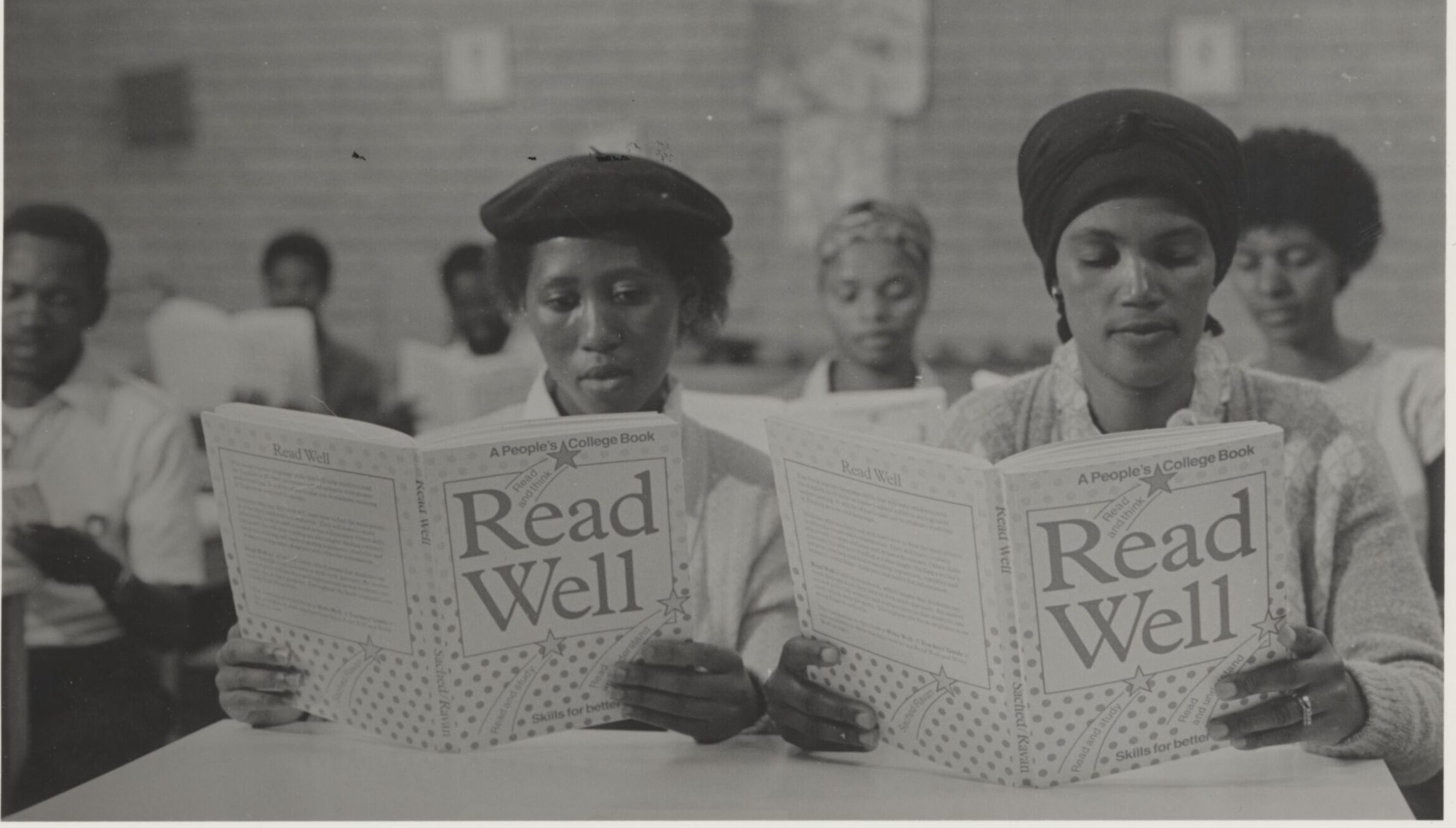
The case study looks at SACHED’s history, its methods of education and philosophy, its funding, among other things, as well as its changing role in the struggle against apartheid.
It shows how SACHED developed from an organisation supporting Black students excluded from universities into an important anti-apartheid educational organisation. SACHED was launched in 1959 and later helped establish Khanya College in 1986 and activists. Its approach was influenced by ideas of education for liberation and critical thinking.
The ideas of Brazilian educator Paulo Freire also influenced radical educational work in South Africa. Freire challenged what he called “banking education”, where teachers simply deposit knowledge into students instead of creating opportunities for dialogue and critical thinking. For Freire, education should involve people thinking about their lived experiences and acting to change their conditions.
This connection between education and people’s lives and struggles was also important to Khanya College. Founded in 1986 as a SACHED project, Khanya initially provided university access courses for people who had been active in community and mass organisations.
Education was therefore connected to the organisations and communities from which students came, rather than being seen only as a route to individual advancement.
Tumelo George Mashiloane, from Middelburg and a member of the Khanya College WhatsApp Study Group, spoke about this legacy.
“The impact of Khanya College was so positive because it continued with the spirit of education for liberation that was carried by SACHED, so that those who were excluded can find access to education. Khanya College’s impact reached various communities in South Africa. Children, adults and older people received education meant to liberate them.”
Mashiloane added, “The Jozi Book Fair is one of the greatest examples of education for liberation. This includes other programmes such as skills programmes and learnerships so that many children, adults and older people can advance.”
He also reflected on SACHED’s relationship with political organisations and the wider liberation struggle, saying these relationships helped connect education with political organisation.
For Khanya staff and study group participants, the reading also became an opportunity to reflect on the organisation’s work today.
Hlengiwe Magubane, JBF Organiser at Khanya College, said the reading helped her understand Khanya’s approach to education.
“I learnt that Khanya implements Freire’s methodology of critical thinking and dialogical conversations. I also reflected on the work we do at Khanya. I learnt that I am able to learn from other people and the importance of education being meant to liberate people rather than being about credentials. It taught me about political consciousness and being aware of your surroundings. Khanya is still promoting social justice and uplifting working-class communities through education for liberation.”
Chris Morris, a member of a Khanya College Study Group and a craft production student at Imbali Centre in Newtown, reflected on how Khanya has adapted over time.
“Khanya started off as a bridging course for university but always linked to the struggles faced by people. Khanya has shown adaptability to change its focus as the political and social climate changed. But the focus has always been to promote political education and consciousness raising. I think it showed flexibility and maturity. It also contributed to sharpening ideas and intellectual culture and traditions, as people were able to debate and share ideas.”
Vuyisani Gwebani said the reading helped him understand the relationship between education and political struggle.
“Khanya College was not just a school, but a political camp in a way that empowered me politically through the Study Groups and the material we have received. It helped me a lot in my political journey to understand class, capitalism, the road to Soweto and other topics. It opened my eyes and sharpened my political knowledge.”
He said the history of SACHED also helped him understand how education had been used in the struggle against apartheid and Bantu Education.
The history of SACHED shows that education was not seen as separate from the struggle for social change. Its work reached people who were excluded from formal education and created spaces where people could learn, discuss their conditions and connect knowledge to action. It also faced the challenge of remaining independent and critical rather than simply becoming a service provider.
Forty years after its founding, Khanya College continues to operate in Johannesburg and work with working-class and poor communities. Its programmes include education, training, publications and research, with an emphasis on participation, organisation and social mobilisation.
For those who took part in the discussions, the SACHED case study is therefore more than a history lesson. It provides an opportunity to think about the role of education today. Education for liberation is not only about obtaining a certificate. It is also about developing the ability to think critically, understand the conditions people live under, participate in community life and contribute to building a more just society.
This article is an opinion piece submitted on 04 September 2026. The views expressed by the author do not necessarily reflect those of Karibu! Online or Khanya College. You may republish this article, so long as you credit the authors and Karibu! Online (www.Karibu.org.za), and do not change the text. Please include a link back to the original article.

