
 Download PDF
South Africa is a country with a population mostly consisting of working communities.
These communities are mainly Black (referring to African, so-called Coloured, and Indian) people who live below the breadline. Many are dependent on the social welfare system in the form of social grants such as the Social Relief of Distress (SRD) grant, or the older person’s grant.
Working class communities also face many problems including poverty, unemployment, crime, substance abuse and addiction, human trafficking, sexual violence, destitution, child abuse, and illiteracy. There is a general lack of access to quality education, healthcare, and opportunities.
The social welfare system through the Department of Social Development (DSD) was put in place to address these ills and provide sustainable resolutions through:
The distribution of social grants to vulnerable individuals. This could be done through
establishing a relationship with nonprofit organisations to reach communities.
Another way is by hiring skilled and trained Social Service Professionals. These practitioners must provide support, care, and advocate for the rights of people in the communities.
Many social problems within communities are, complex, and constantly need addressing. This creates a great need for social welfare and social justice organisations, as well as practitioners, to work with the most vulnerable within communities.
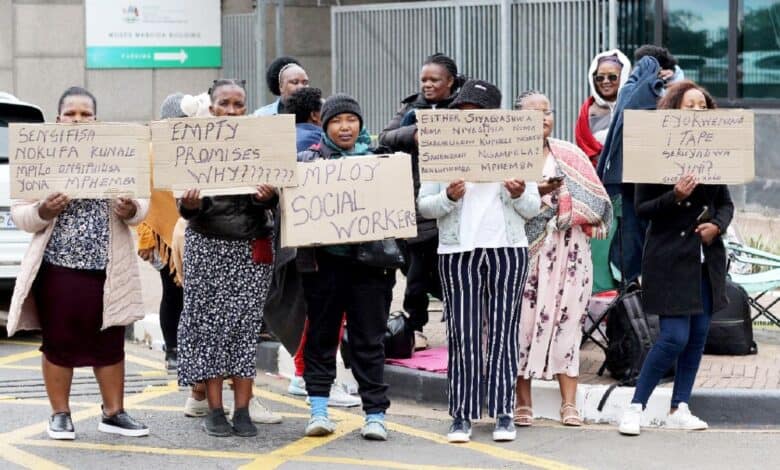
And yet, in South Africa, we have practitioners with a wealth of experience, education, skills, and training, currently unemployed. We have organisations that offer services, such as shelter for abused women, closing doors due to funding cuts.
Some practitioners work under impossible conditions with a lack of professional support, inadequate resources, and unstable livelihoods. Again, this is due to constant funding issues by the DSD.
The recent Notice to Exempt issued by the SA Council of Social Service Professions speaks to the severity of unemployment among social service professionals and practitioners.
Out of the 20 professionals interviewed for this article, 12 said if they had other options they would have quit the profession.
Five said they are actively studying for qualifications in other fields while two said they still have a passion for the work but are constantly frustrated.
One said she would be resigning at the end of the financial year to protect her mental health.
A country like South Africa with majority of black people who are poor and desperate, cannot afford to ignore the problem. Many young people are in the grip of so many challenges, South Africa should deploy the very people who are trained, skilled, and willing to provide critical and essential services to the most vulnerable amongst us. Can this country with Gender Based Violence statistics constantly on the rise afford to lose practitioners and close social care organisations?
SA communities are in crisis and faced with insurmountable challenges and the continuing laying off of social workers and neglect of social service and social justice organisations will eventually lead this country to social decay with the most vulnerable paying the ultimate price.
This article is an opinion piece submitted on 21 January 2025. The views expressed by the author do not necessarily reflect those of Karibu! Online or Khanya College. You may republish this article, so long as you credit the authors and Karibu! Online (www.Karibu.org.za), and do not change the text. Please include a link back to the original article.

