
 Download PDF
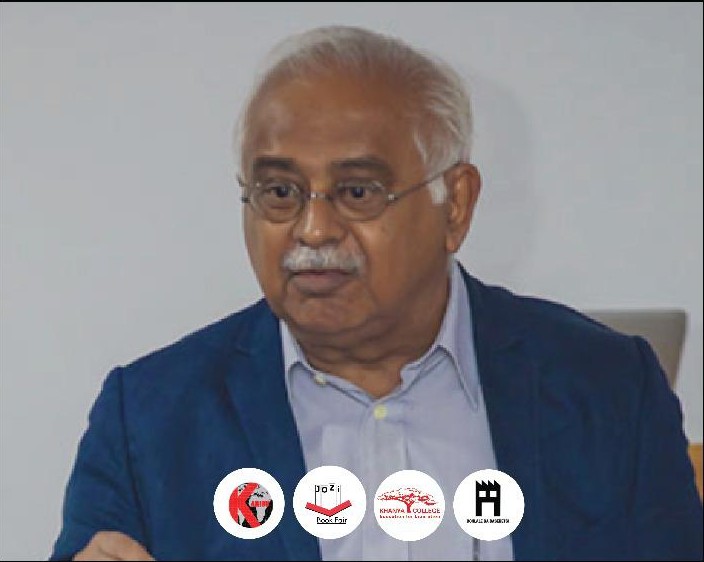
 This year, the 17th Jozi Book Fair, welcomed one of Africa’s most respected intellectuals in Africa, Professor Issa Shivji, to deliver the keynote address titled The Role of the Revolutionary Intellectual in Times of Crises. For many in attendance, especially young activists and participants in the study groups earlier that morning, this was a rare opportunity to learn from a someone who has, for decades, insisted that another world is possible.
On 31 October 2025, a group of young people who are part of the study group spent the day in conversation with Professor Shivji, it was a moment filled with gratitude and inspiration. Professor Shivjis engagement with the study groups reminded the study groups of many of the foundations of political education, which are spaces where “collective learning shapes a collective understanding”. The discussions were centred on whether the concept of class and the theory of class struggle are applicable to Africa, and what their relevance is for the struggles for justice today.
The session opened with groups drawing connections between class struggle in South Africa and class struggle in Tanzania. For nearly a month, the study groups had been reading Professor Shivji’s book, Class Struggles in Tanzania. Many participants shared that the book was not easy, but they persisted, struggled together, and completed it together, the group also noted when they started reading the book, the group was big but as they continued reading the group became smaller. Professor Shivji commended their commitment, explaining that he wrote the book when he himself was a student participating in intense study groups. At the time, he recalled, their guiding motto was: “You need to struggle to learn and learn to struggle.”
During the session, Professor Shivji unpacked the different classes that make up society and explained how the capitalist system enriches the ruling class while exploiting the working class. He was patient and generous in his engagement, using local examples to explain how capitalism continues to benefit the elites. As the discussion continued, he took up questions while unpacking the dynamics of class struggle in society, creating a safe space for participants to engage, discuss, and learn from one another, and from himself.
“It was a pleasure meeting and discussing these issues with the Professor. I will definitely take this with me and encourage my peers to read,” said Ntokozo Mohlaoli from New Bronville, Free State.
Later that day, Professor Shivji, delivered a keynote address at the 17th Jozi Book fair public dialogue. Maria Van Driel, the Khanya Director introduced the intellectual by emphasising that Professor Shivji has long affirmed and reaffirmed that transformation is possible when ordinary people act with each other and in solidarity with one another, even in the darkest moments.
During her welcome remarks, the Khanya Director, confronted an uncomfortable reality, that intellectual life in South Africa remains dominated by university and elite discourses that are centred on race, class, and gender and that is often disconnected from the broader African experience. Emphasising that within this environment, it is easy to feel alienated from the continent’s intellectual traditions that are grounded in the struggle and in community.
Professor Shivji opened his lecture by paying tribute to the late Comrade Oupa Lehulere, the former Khanya director and, a committed activist, he also thanked Maria van Driel, Khanya Director, Khanya College and Jozi Book fair for organising the event.
In his lecture Professor noted that intellectual work cannot be separated from the experiences of working people. “As intellectuals we often think we have the keys to everything,” he remarked, “but we don’t.”
Professor Shivji explained the world today as being in the midst of crises, ideological crisis, ethical crisis, and socio-economic crises. From Gaza to global inequality, from the erosion of truth to the deep-set out of morality,” humanity is at a crossroads”, he remarked.
One of his most critiques was directed at the human rights discourse, which has dominated African conversations and shaped many African liberation movements. Yet today, he argued, the problem is not simply “double standards,” but the total collapse of standards altogether. “What standard,” he asked, “can be applied to Gaza today?”
Tracing this back historically, he pointed to Libya, Iraq, Somalia, and Syria, nations destroyed in the name of “humanitarian intervention.” He reminded the audience that Muammar Gaddafi’s push for an African Central Bank represented a direct threat to global capitalism, and that the moral language of “human rights” was weaponised to justify regime change.
Professor Shivji urged African intellectuals to interrogate the foundations of the rights discourse, a doctrine deeply rooted in individualism and often disconnected from collective liberation.
“Another ideological terrain in crisis is nationalism”, he said. Nationalist movements that once fought for liberation have, in some cases, slipped into xenophobia, authoritarianism, and even genocide. Shivji argued that Africa must confront the deep contradictions within its own nationalism.
The Non-Governmental Organisation (NGO) sector was also not spared. Funded from outside, NGOs often moved former liberation struggles to activists, replacing mass struggle with workshops and reports. Today, with global funding redirected into geopolitical conflicts such as Ukraine, even the NGO model itself is collapsing, it is in crisis.
One of the most powerful parts of Shivji’s lecture was his critique of the privatisation and commodifying of education in Africa. He said education was once a public good, but today it has become a commodity. “Universities are told they are productive.”
Those who have money go to private university and those who dont go to public university, Private schooling has deepen class divisions, it has created an entire generations detached from the languages and cultures of their own people. “In Tanzania,” he explained, “children in private schools cannot speak Swahili.
Knowledge, he argued, cannot be privatised. It cannot belong to markets or to elites. Yet today, students are encouraged not to think, but to pass; lecturers are pressured to pass students. Professor Shivji defined what is the work of revolutionary intellectuals today as:
- A return to pan-Africanism, not as rhetoric but as a living, breathing political project.
- A commitment to cultures grounded in struggle, not in commodity or elite spaces.
- Anti-capitalist and anti-imperialist, intellectuals must refuse to change or soften the realities of capitalism.
- A grounding in the struggles of working people, by recognising that real knowledge is produced in the process of collective resistance.
- Must have the responsibility to expose false reconciliation, which have become forms of class collaboration rather than liberation.
Professor Issa Shivji’s keynote was a call to action. It asked difficult questions about the intellectual traditions we receive and the ideological structure we accept. It reminded us that liberation is not an academic exercise but a collective struggle. And, as he reminded the young people in the study groups, “when we learn to struggle and struggle to learn together.”
This article was submitted on 06 November 2025. You may republish this article, so long as you credit the authors and Karibu! Online (www.Karibu.org.za), and do not change the text. Please include a link back to the original article.

