 Download PDF
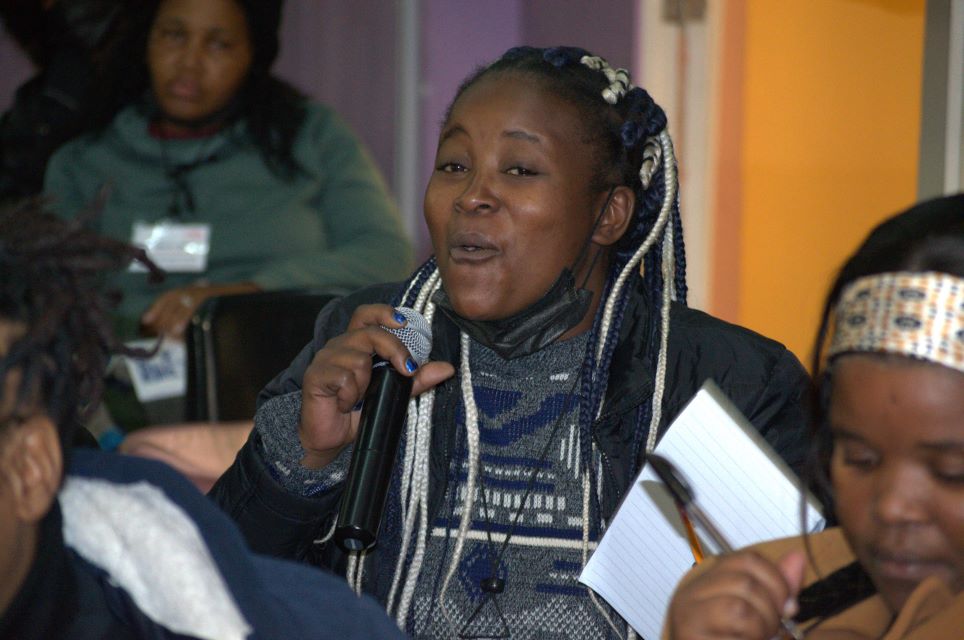
On Monday, 16 June 2025, nearly 70 activists from all over Gauteng and beyond gathered at the House of Movements in Johannesburg for the start of this year’s Winter School, hosted by Khanya College. With the theme “Rebuilding Communities and Solidarity,” the week kicked off with high spirits, warm welcomes, and important conversations about the state of working-class life in South Africa.
The school began with a check-in session where participants shared how they slept and how they felt after arriving the day before. Most were happy and excited. While some raised small issues needing fixing, the energy in the room was positive, showing a shared commitment to making the week work for everyone.
This school is special because it is not only run by Khanya College—it is run by the people. Comrade Nosipho Mdletshe, one of the coordinators, reminded participants that this is a school of activists, not just for activists. Everyone shares responsibilities: cooking meals with staff, cleaning up, taking notes, and writing the school’s own newsletter. These small tasks are a big part of building collective spirit and working-class unity.
The day opened with singing and fun icebreakers led by Father Mokesh Morar and other participants with strong church backgrounds. The music and laughter helped set a tone of joy, care, and togetherness—something often missing in the day-to-day struggles of poor and working-class communities.
Since 2000, Khanya’s Winter School has been a space for learning, building solidarity, and organising for social justice. Activists young and old, from townships, informal settlements, unions, and community groups, have attended over the years—including people from other African countries and beyond. This year, the youth made up the majority, something that all speakers celebrated.
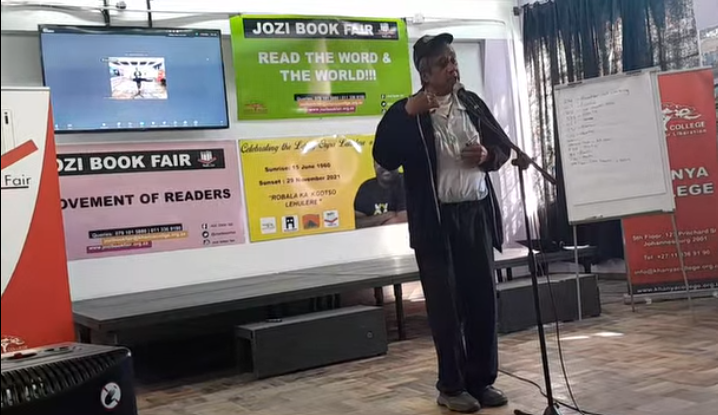
Father Mokesh opened the talks by pointing to the deep crisis in the country. He spoke about the corruption in government and how the elite continues to deny services to the poor. He asked a serious but funny question: “Who wants to be a minister of potholes?” – making people laugh while also pointing out how badly basic services are managed. He reminded the youth that those in power often only care about what they can take, not what they can give. “It’s always, ‘what can you do for me?’” he said.
Next up was Dr. Mondli Hlatshwayo, a long-time activist and Khanya board member. He expressed joy at seeing so many young people and said it gave him hope for the future. “Khanya lives on in you,” he told the youth. But he didn’t hold back in his criticism of those in parliament, saying many just show up to secure their pensions and are often caught sleeping during working hours. He stressed that the future of the working class depends on the next generation building strong movements based on justice and honesty.
He also spoke about the rich mix of people in the room, with older activists bringing years of experience and young people bringing energy and fresh ideas. “Some wished us dead,” he said, referring to those who think Khanya’s time is over. “But we are still here, and you are proof of that.”
Dr. Maria van Driel, director of Khanya College, gave the final keynote of the day. She spoke about how 30 years of democracy has also meant 30 years of neoliberalism, where people are pushed to focus only on individual survival. She said this has broken down the strong sense of community that once existed in working-class life—like in stokvels and local support networks. “Now everyone’s just trying to survive alone,” she said. “Violence is rising. People are struggling. So we must ask: How do we rebuild? How do we bring back peace and justice?”
Van Driel called on young people to build a culture of reading and thinking critically—especially about religion, power, and politics. She spoke about the Jozi Book Fair, which Khanya runs to promote reading, and said learning is one of the key ways working-class people can change society for the better.
This article was submitted as part of the Imbila Yesu publication produced daily for the duration of the Winter School in 2025 (15-19 June 2025). It appeared in Edition 2, released on 17 June 2025. You may republish this article, so long as you credit the author and Karibu! Online (www.Karibu.org.za), and do not change the text. Please include a link back to the original article.