
 Download PDF
Khanya College was founded in 1986 during the height of the struggle against apartheid capitalism. The Vaal Uprising, which began in 1984, spread rapidly across the country. Commentators characterised it as an insurrectionary moment in which the working class experimented with self-rule in their communities and workplaces. This movement emerged from the Durban strikes of 1973, while students had been organising intensively since the late 1960s. Together, workers and students formed a strong force that confronted apartheid capitalism directly.
In response to the uprisings, the apartheid regime declared a state of emergency in 1985 and 1986. It was in 1986 that Khanya College was established, following a series of discussions within the South African Committee for Higher Education (SACHED), which had been formed in 1959 to respond to the racist and tribalist Extension of University Education Act of 1958. Although academic and quite different from today, Khanya College provided the working class with progressive options to access higher education, pioneering new means in the country at the time.
The transition to democracy presented significant challenges for Khanya College, as it did for many organisations. This shift led to the abandonment of the traditional academic programme in favour of providing dialogical education and research aimed at strengthening trade unions and community organisations in the post-apartheid period. As trade unions became increasingly influenced by the ruling class and the African National Congress, Khanya College oriented its efforts towards social movements actively engaged in struggles against neoliberalism. These struggles were particularly evident through crises related to housing, water, and electricity in the 2000s.
Khanya College emerged as a vital resource for these movements, acquiring a building known as the House of Movements, which served as a political and technical infrastructure. Notable events included the large march from the working-class community of Alexandra to the affluent suburb of Sandton during the World Summit on Sustainable Development in 2002, as well as the anti-xenophobia march in 2008 in downtown Johannesburg. In 2001, Khanya College, in collaboration with its social movement and NGOs allies, sent a significant delegation to the World Conference Against Racism and Xenophobia held in Durban.
As the movements began to decline, Khanya College took the opportunity to reflect through the All-College Conference (ACC). The ACC of 2014 agreed to orient Khanya’s focus on the primary organisations of the working class that, while not explicitly political, represented a collective response to the crisis of neoliberalism and the challenges facing the working class.
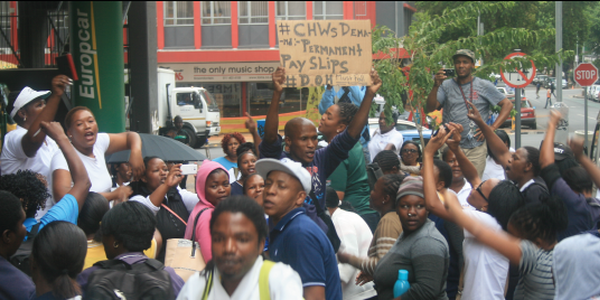
Before the orientation of 2014, intense research was conducted by Comrade Maria van Driel on the changing family structure within working-class communities. This work, among others, identified black women in these communities as emerging social agents. Following this, Khanya College started to organise what were then called home-based caregivers. As the organisation of these home-based caregivers—most of whom were women—intensified, the political language evolved, and Khanya College and these workers became known as Community Health Workers (CHWs).
After a series of workshops, research initiatives, educational efforts, and mass mobilisation, the CHWs achieved a remarkable and historic victory in the context of chronic neoliberalism. They managed to secure gains that seemed unlikely in such challenging circumstances. They snatched victory from the jaws of defeat. In 2020, the CHWs became permanent employees of the Gauteng Department of Health, earning three times their previous income and receiving additional benefits. However, the CHWs eventually stepped back from the struggle. Now, Khanya College and other CHWs in Gauteng and various provinces are using the lessons learned from the CHWs’ victory to rebuild resistance. Continuing resistance and struggle have been especially important because the CHWs began a healthcare movement beyond just attaining permanent employment by the Gauteng Health Department.
Other successful interventions include training community journalists from working-class communities, who form the backbone of the new working-class media and the working-class newspaper called “Karibu,” which means “welcome.” Additionally, children and young people are engaged in reading and producing plays, which helps to strengthen and deepen the cultural and analytical work within the working class.
Since the last ACC, significant progress has been made. Comrades are encouraged to read the political report delivered by Comrade Maria van Driel at the 2025 ACC. There are challenges, such as funding issues and limited human resources. However, the Khanya Winter School of 2025 has shown that young people and women represent both the present and the future of working-class resistance. Khanya plays a crucial role in revitalising the fighting spirit of the working class. Khanya is not constructing an empire; rather, it serves as a resource for the working class—both for employed workers, often in precarious positions, and for the unemployed.
Khanya will celebrate its 40th anniversary next year, and as we approach this milestone, it is essential for the ACC to engage in thoughtful strategic planning for the next decade. This forward-looking approach will set a strong foundation as the college prepares to commemorate its 50th anniversary in 2036.
Mondli Hlatshwayo
Khanya College Board Member
This article is an opinion piece submitted on 30 June 2025. The views expressed by the author do not necessarily reflect those of Karibu! Online or Khanya College. You may republish this article, so long as you credit the authors and Karibu! Online (www.Karibu.org.za), and do not change the text. Please include a link back to the original article.


