
 Download PDF
South Africa has only recently emerged from the deep, dark apartheid past. During that period, Black workers lacked general labour protections and worked in appalling conditions, before eventually securing rights such as the right to protest, compensation for injury at work, and a minimum wage, through intense organisation of labour. Under apartheid, workers who demanded better wages were brutally oppressed and killed by the National Party government from 1948 until the dawn of democracy in 1994. Following the democratic elections in 1994, the message that South Africa gave to the world was one of beautiful promise, advanced development, and the improvement of black people’s lives. This was because black people were systematically excluded from services, social development programmes, and generally lacked upward mobility.
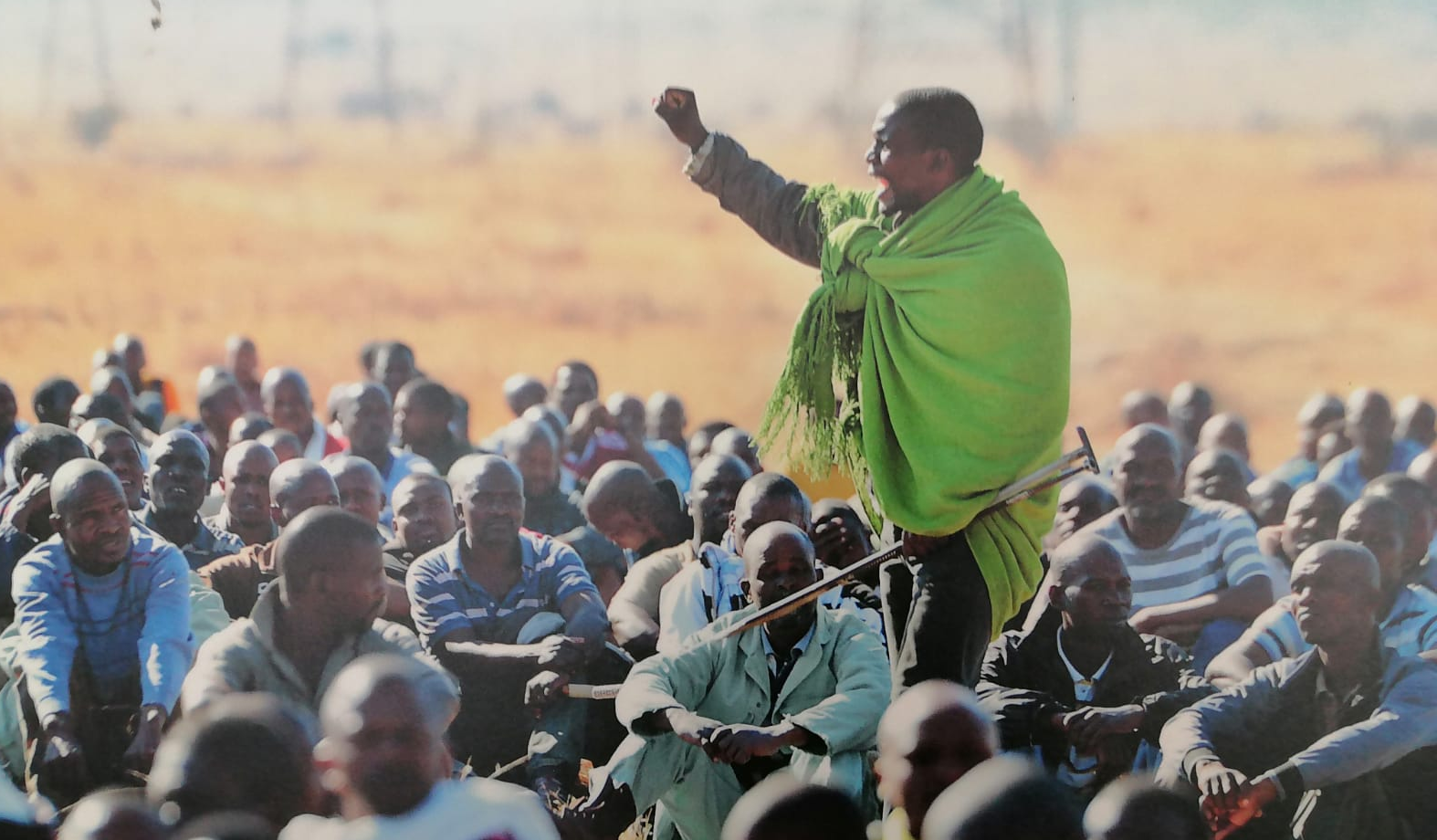
Despite these promises, captured by former President Nelson Mandela saying, ““Never, never and never again shall it be that this beautiful land will again experience the oppression of one by another,” the ANC government directly contradicted that declaration. On 16 August 2012, in the so-called democratic South Africa, the world once again witnessed the killing of mineworkers in Marikana live on television. These were an estimated 3,000 rock drill operators who were demanding a living wage of R12,500 so that they could afford to care for their families.
It is puzzling that it was under the leadership of the Black government when the gruesome killing of 34 mineworkers happened, and since then, the government has failed to advocate for justice. History tells us that the African National Congress was established to advocate and fight for every oppressed citizen, including marginalised workers in South Africa. Even though the ANC (and now the ‘Government of National Unity’) casts itself as a pro-poor government, it has consistently legislated against the working class.
The Growth and Redistribution policy, also called GEAR, is perhaps the standout policy proving this. In the opening, Patrick Bond (Tokenism in South African social policy), notes, “South Africa’s welfare state expansion is said to be one of the leading ‘social democratic’ achievements of the post-apartheid era. However, overwhelmingly tokenistic features – including a neoliberal (fiscally-austere) context, the extension (not transformation) of apartheid’s inheritance, and commercialisation of state services – mean the deeper crises of society and economy are not being addressed effectively by the state.”
Against the backdrop of this situation, mineworkers in Marikana undertook to protest for R12500, feeling the endless pinch of falling standards of living and expensive goods and services, in a country constantly commercialising services. On that fateful day, the world saw what the ANC government truly represents. They protected the interests of the capitalists instead of siding with the workers. The government protected Lonmin, a mine owned by Westerners with a colonial past (the British) who have historically exploited Black workers in South Africa, paying them very low salaries.
Indeed, the history of society has nearly always been a history of class struggle: the bourgeoisie, meaning the capitalists, against the proletariat, meaning the working class. On 16 August 2012, the day of the Marikana massacre, class warfare became evident; the ANC government revealed its deepest outlook – that it does not care about workers’ demands but only profits.
Amandla to the spirit of the Marikana workers
This article is an opinion piece submitted on 12 August 2026. The views expressed by the author do not necessarily reflect those of Karibu! Online or Khanya College. You may republish this article, so long as you credit the authors and Karibu! Online (www.Karibu.org.za), and do not change the text. Please include a link back to the original article.


