
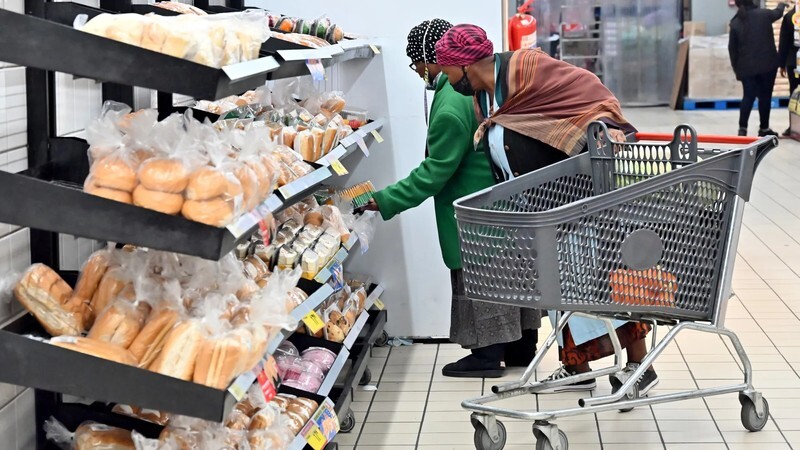

The cost of living in South Africa has risen sharply since 2018, early in the term of incumbent President Cyril Ramaphosa. Such a trend has arguably shaped much of South Africa’s recent social disruption, especially when coupled with the decline in political consciousness and left-wing politics in the country generally.
The cost of goods and services has increased substantially since 2018. A cumulative calculation based on consumer price data puts the increase in prices since 2018 at around 40%, although this varies depending on the period used. Stats SA measures these changes through the Consumer Price Index (CPI), rather than through a single “cost of living” figure.
Over the same period, unemployment has also increased. The unemployment rate climbed from 26.9% in 2018 to 33.6% in the second quarter of 2026, an increase of 6.7 percentage points, according to the unemployment series reported by Trading Economics using data from Statistics South Africa. The 33.6% figure, released in August 2026, is up from 32.7% in the first quarter of the year.
The Pietermaritzburg Economic Justice and Dignity (PMBEJD) compares the cost of a household food basket across South Africa, including Johannesburg (Soweto, Alexandra, Tembisa and Hillbrow), Cape Town (Khayelitsha, Gugulethu, Philippi, Langa, Delft and Dunoon), Durban and Mthatha, among others. According to its July 2026 report, the average Household Food Basket for a family stands at R5,530.52. In Johannesburg, the basket costs R5,763.70.
This amount is generally impractical for many people working in retail outlets, on farms and as security officers, particularly when their wages must also cover transport, housing, electricity and other household expenses. This is especially concerning because many workers must support several members of their households on a single income.
This represents a problem rooted partly in apartheid spatial planning. In South Africa, economic centres are generally located at considerable distances from where many working-class people live. As a result, the budget for any month must factor in transport costs. With increases in fuel and transport costs over the period discussed, families are also being pushed to spend less money on groceries and other necessities. PMBEJD has previously highlighted the impact of transport costs on household affordability, particularly for low-income families.
However, many families do not earn enough to meet their basic needs and rely on social grants. These range from the Older Persons Grant to the Child Support Grant. Stats SA’s 2025 General Household Survey recorded 25.324 million people receiving social grants, relief assistance or social relief. This shows the importance of social assistance to millions of households, although it is more accurate to say that millions of people rely on grants than to say that nearly half of the population receives SASSA grants.
The Social Relief of Distress (SRD) grant was introduced during the COVID-19 pandemic in 2020 and became another important form of support for unemployed and vulnerable people.
The 2026 household survey conducted by Khanya College, whose detailed outcomes will be shared later this year, also gives a glimpse of the difficult living and economic conditions in areas such as Eldorado Park, Kliptown, Klipspruit and Slovo Park, where some families have had no one employed for several years.
In closing, it is worth noting that PMBEJD’s analysis of affordability is based on the relationship between people’s incomes and the cost of goods and services. Workers earn wages to support their families and should reasonably expect their income to cover the basic costs of living with dignity. In many Black South African households, one family member may be the main wage earner, meaning that a single income must support several people. This makes the relationship between wages, food prices, transport costs, and other household expenses particularly important.
This article is an opinion piece submitted on 18 August 2026. The views expressed by the author do not necessarily reflect those of Karibu! Online or Khanya College. You may republish this article, so long as you credit the authors and Karibu! Online (www.Karibu.org.za), and do not change the text. Please include a link back to the original article.

