
 Download PDF
The All College Conference (ACC) is a key feature of Khanya’s work and renewal. While it aims to analyse its work over a defined period and helps Khanya form perspectives for the road ahead, the role of the ACC is to understand the context in which the work of Khanya College is taking place. The next edition of the ACC is on 20-22 June 2025.
Khanya College originated as a project of the South African Committee for Higher Education (SACHED) in 1986 but has been independent of SACHED since 1993. It has developed into an important institution for the working class in South Africa, working with constituencies and poor communities. Khanya College seeks to “respond to the challenges posed by the forces of economic and political globalisation.”
The last ACC was held in Johannesburg from 29 to 31 May 2014. Over 70 activists, representing more than 30 social movements, community-based organisations, civil society, and other constituencies, as well as College staff, participated in discussions, from which Khanya developed perspectives for its work moving forward.
Between 2000 and 2014, Khanya focused its social justice work toward the secondary organisations of the working class. For example, Khanya’s programme focused a lot on worker education content and did capacity-building work with trade unions and their members, as well as social movements such as the Anti-Privatisation Forum, Jubilee South Africa, the Landless Peoples Movement and others.
The 2014 ACC took place in the context of a weakening working class facing multiple crises, as many of its institutions formed during the apartheid era collapsed. The Marikana massacre in which 34 miners were brutally killed by the democratic government in 2012 and the formation of the Economic Freedom Fighters, led by former members of the African National Congress, a year later, all had a meaning for Khanya’s perspectives. What these developments meant for democracy less than 20 years since 1994, along with the death of social movements that had been very strong, led Khanya to adjust its strategic direction. The College now focused on working with the primary organisations of the working class.
Following the discussions, Khanya embarked on three main programmes. It established a programme with the Home-based Carers (HBC) respond to healthcare survival needs, especially HIV/AIDS. Additionally, Khanya launched the Mass Advice Day (MAD) work and the youth programme, Tsohang Batjha! (TB), to provide access to rights and to address the junking of education and the decline in generic capacities, respectively.
The importance of the primary organisations for Khanya were that they are, “involved in the daily reproduction of the working class…produce its leaders at a community level, and are reproduced spontaneously within the working class.” Khanya also wanted to help develop leadership in the already existing working class organisations and movements, through self-education. Its preferred method has been the study group method.
This year, the College has issued invitations to its constituencies, partners, and individual activists in the social justice movement to evaluate the work Khanya has done since the last ACC. In the present period, Khanya has continued work with youth in the form of TB but also the Poetry Buddies (8 to 9-year-olds).
There are notable achievements as the programme has produced book series such as the Poetry for Friends (up to six editions) and countless short stories written by adolescent writers participating in the TB programme, through the short story competition. Before COVID-19, the youngsters who participated in Khanya’s youth programmes consistently did remarkably well in Spelling Bee events, outdoing privileged learners.
The HBC programme produced a very strong group of Community Healthcare Workers (CHWs) who organised themselves as the Gauteng Community Health Care Forum, leading to CHWs to be absorbed by the Gauteng Department of Health as permanent employees. Although this chapter has since closed, the goal of the CHWs envisaged by them and Khanya as their supporting structure, was not achieved because they aimed to establish their own clinics and healthcare for working class communities. COVID-19 had a negative impact on many working class organisations as well.
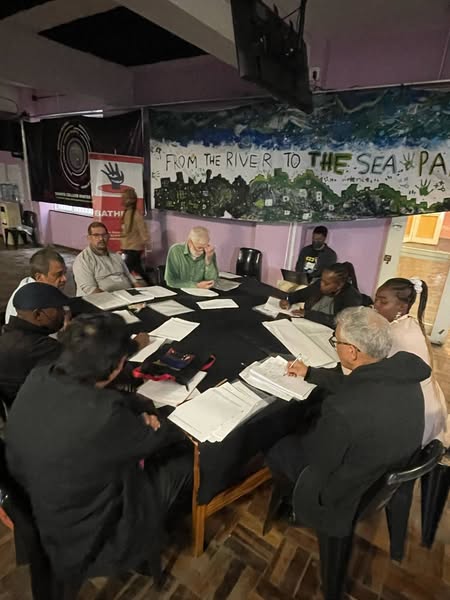
The evaluation discussions starting on 10 April 2025 at the House of Movements in Johannesburg, with coordinators from the Orphaned and Vulnerable Centres (OVCs), with which Khanya has worked since the last ACC, will play a role to assess where Khanya is and needs to go in the social justice struggle. The meeting will also include journalists the College trained through the Forum for Activist Journalists.
On Saturday, 12 April 2025, Khanya will host additional constituencies to continue the discussions and debates reviewing the 2014-2025 period, during which it primarily worked directly with the organisations of the working class from community health activists, civic society organisations to out-of-school youth, children, casualised workers, ex-Khanya staff etc.
The goal of the discussions will be to review Khanya’s activities and programmes, assess their effectiveness, and identify challenges facing Khanya College as an organisation and institution. These discussions also aim to strengthen Khanya’s work with its constituencies and serve as a form of accountability to them.
Khanya College staff are working hard to ensure the preparatory meetings and the ACC itself will be a success. We are looking forward to productive meetings that will chart the period ahead, assisting Khanya to better do its work of movement building, education for liberation and playing its role as a catalyst in social justice movement in South Africa.
This article was submitted on 18 April 2025. You may republish this article, so long as you credit the authors and Karibu! Online (www.Karibu.org.za), and do not change the text. Please include a link back to the original article.

