 Download PDF
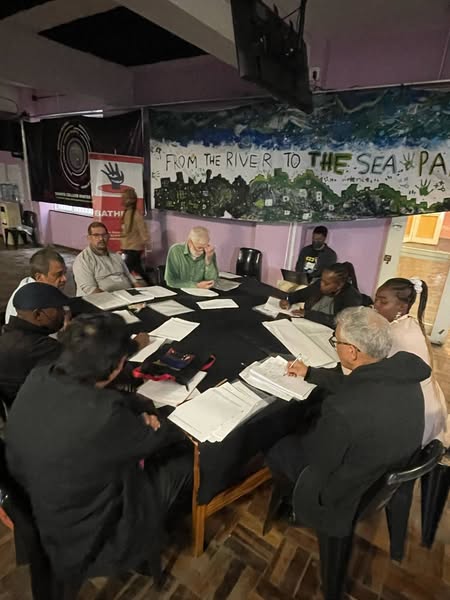
Khanya College held discussion events in the build-up to the All College Conference (ACC). The events with coordinators, out-of-school youth, and social movements, took place on 10 and 12 April 2025, respectively.
The participants at these sessions learned more about Khanya’s work throughout its history and how the College has used ACCs to review and rethink its work and assume a different direction if needed. Khanya has throughout the years changed its orientation after every ACC.
“Originally, Khanya College was an academic institution to transition black students from high school to go to university, to give black students support in reading and writing. To help them so they can go to university for their second year. From 1990, Khanya College changed and oriented to being a social movement,” said the College director, Dr Maria Van Driel.
The participants talked about burning issues from their communities. Some of the issues raised were violence, including crime and gender-based violence, water crisis, inequality, high unemployment rates, teenage pregnancy, poverty, and substance abuse. The participants found that their communities shared many of the same problems. After bringing up these problems, the participants also suggested solutions and community efforts to survive. Some initiatives include agriculture to prevent unemployment and starvation.
Khanya College recognises the importance of solidarity and how neoliberalism has affected our society. In evaluating what the impact of neoliberalism has been, the discussions were framed around youth, schools and education, service delivery, family households, and communities. After assessing the kinds of setbacks that communities are seeing and rising unemployment in tandem with the rising cost of living, spikes in crime, etc., the activists concluded that neoliberalism is changing society and that’s why we need more activists and movements such as Khanya.
Nolusindiso Balati, 36, from the Unemployed Peoples Movement active in Makhanda, shared her insights as a participant at the discussion conference. “The conference was such a great initiative; I learnt a lot and gained more experience. What stood out for me was the worksheets that were given to us, which made me realise we face similar problems in our communities. All in all, Khanya College needs to extend these conversations so that we can go to our communities and implement them,” she said.
The conference also reviewed the VAT increase proposed under the Government of National Unity despite the current impasse. Activists gave an insight on the conversations that were taking place in their respective communities about the looming VAT hike, saying people on the ground are worried about the cost of food especially. In a surprising revelation, many activists said that they thought that the SRD R370 grant to unemployed people should be cancelled. This opinion was based on a common understanding that many people misuse the grant to support addiction and drinking alcohol. Many other participants disputed the assessment as a generalisation because many families find the SRD useful.
Lawrence Simelane, a 34-year-old activist from Page to Stage Edutainment Hub based in Protea South, Soweto, and Lenasia Ext 9, said, “It was a very productive meeting, and it shows the importance of evaluating the burning issues in communities and also the importance of engaging in such conversations. Having to know the people’s views and opinions on the GNU, VAT increase and any other issues that are affecting the communities, and how the communities are coming together to solve these issues.”
Are there helping organisations? What victories have communities achieved? “Khanya College is an organisation that helps community people to [learn how to] read, write, and be able to resolve issues themselves. Through Khanya College, I have developed more through the culture of reading and writing, and it has also given me ideas on developing campaigns through the theatre plays that I am creating,” he continued.
“The meeting at Khanya was an encouragement for us as activists to continue with activism and fight for our communities. We were taught ways to organise to fight challenges in our communities instead of just talking about the challenges. Khanya did not only give us resources but offered skills to fight in a louder way, like writing articles to break the chains of silence. We were also taught the power of reading and writing to increase our knowledge as activists,” said Sinalo Peyi, 26, from the Isikhalo Women’s movement, summing up the conference and experience as a regular at Khanya events.
Following an input by the Khanya director, Dr Van Driel, many of the young activists were enlightened about why Khanya does the work it does and why it works with the working class.
These discussions are leading what will be a series, with more to come before the ACC is held in June 2025. On 21 to 23 June 2025, there will be activists from different communities, provinces, and from across different sectors coming together in solidarity to discuss with Khanya to assess conditions in working class communities. Such an undertaking will help Khanya decide what its work for the next ten years will be.
This article was submitted on 15 April 2025. You may republish this article, so long as you credit the authors and Karibu! Online (www.Karibu.org.za), and do not change the text. Please include a link back to the original article.