
 Download PDF
Newtown Park, Johannesburg
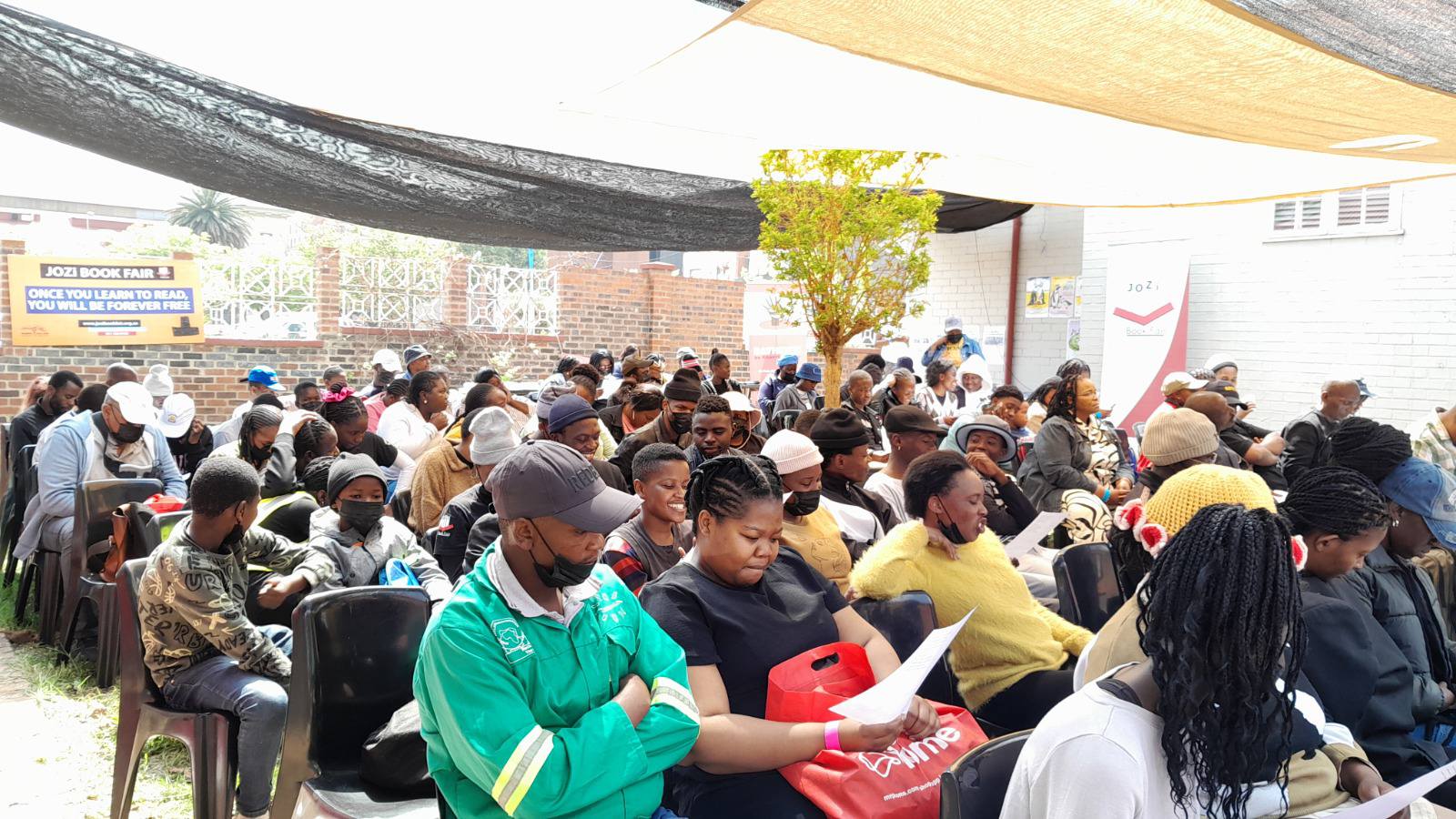
This year is the 18th Jozi Book Fair (JBF), a project of Khanya College that brings together readers, writers, small publishers, artists, activists, and community organisations to converse, debate, and creatively engage arts and culture. The JBF annual festival is a public space for all ages to build a critical movement of citizens.
The JBF was formed in 2009 in response to the poor reading and writing culture in all South Africa’s languages, resulting from the legacies of colonialism, apartheid, and neoliberalism. Since 1995, the democratic government’s neoliberal policies have arguably worsened the generational legacy of poor cognitive and generic skills of children and youth.
The 2021 Report on Progress in International Reading Literacy Study (PIRLS), states that 81% of Grade 4 learners in South Africa cannot read for meaning in any language. This is the same as in 2011, with no progress and time lost to improve children’s education. A Brazilian child in Grade 4 is 3 years ahead of a Grade 4 child here.
The Report highlights a ‘generational catastrophe’, with 4 million primary school children experiencing half their schooling disrupted here, like countries that experienced earthquakes (Pakistan) and the Ebola crisis (West Africa). This affects long-term learning. While girls do better than boys, in 2021, SA has the largest decline in reading outcomes (-31points) of 33 countries, but the government has no plan or budget to catch up on lost learning. This is an irresponsible attitude toward the country’s children and its human resources.
The JBF’s work is therefore vital, encouraging civil society to work together to promote reading and critical thinking in schools and communities. This approach compensates for the absence of libraries at schools and in communities, and government support.
The JBF is open to everyone to host events, exhibit, publish their work, and use all art forms. This breaks with traditional book fairs in SA, usually geared to minority white audiences and big publishers. In contrast, the JBF creates readers and writers throughout the year, and no ‘gatekeeper’ decides on what is art or literature as long as participants are not racist, sexist, or xenophobic. The JBF is a platform for small, indigenous language, and self-publishers, NGOs, progressive authors, academics, artists, communities, and social movements to create a thriving civil society to ‘read the word and the world’.
Theme 2026: Education for Liberation
This year, 2026 marks fifty years since the Soweto Student Uprising in 1976, when thousands of students took to the streets to reject apartheid and apartheid education, designed to reproduce social inequalities between black and white people, limit their futures, and deny their humanity. The students’ struggle became more than a fight against language policy, poor schooling, and education for slavery; but a demand for human dignity and social justice.
1976 rocked the foundations of South African society: while it instilled fear in the ruling classes, it was an awakening for oppressed people, spreading nationally to cities, towns, and dorpies. Soweto was a life-changing moment, especially for young people, that life could be different. The old way of living was no longer acceptable. The youth swelled the ranks of the liberation movements broadly, organisations in exile, the emerging unions, student, and civic organisations throughout the country. Soweto unlocked the social energy that fed the liberation struggle and brought about democracy in 1994.
Khanya College was formed in 1986, influenced directly by Soweto 1976. Khanya’s mission: education for liberation: to provide black (generic) students to tertiary education and to complete their degrees at the white
universities of Cape Town and the Witwatersrand; to explore relevant education curricula such as ‘education with production’, African Literature and African History; to encourage student participation in the liberation struggle, in civic organisations and unions; and to critically engage the SA social formation.
With the unbanning of political organisations in South Africa in 1990 and removing all racist legislation, including the ‘opening of universities to all,’ Khanya became a community-based college and continued its work with unions, communities, and emerging social movements.
This year, Khanya celebrates its 40th anniversary, a milestone of experiences tied to the liberation struggle for liberation, its history of victories, defeats, and movement building, also the subject of analysis.
More than 30 years later, the spirit of the Soweto uprising is an indictment of South Africa’s democracy and will not rest until new generations redeem the liberation struggle. To concretely honour Soweto 1976, the theme for JBF and Khanya’s 40th anniversary is Education for Liberation, going back to our Soweto roots!
The theme demands that we critically assess this society and the education system(s) that reproduce impoverishment, unemployment, and class inequality in South Africa today.
We need to use the opportunity to examine education at every level of society, from the cradle to the grave. For instance, the conditions prevailing in all schools and institutions, and the curricula?
Why is it that so many children, youth, and young adults still cannot read for meaning? In this context, Artificial Intelligence (AI), will marginalise and make human beings even more disposable, while the children of the ruling class grow up to control the country’s wealth. At the same time, we cannot wait on an irresponsible government; hence, self-education, study groups, and self-organisation are even more important.
How do we encourage our peers – children, youth, and women – to read consistently and be critical thinkers? Education for liberation is about supporting and nurturing intellectual curiosity, creativity, collective learning, and the courage to question injustice. It is about building spaces where learning strengthens communities, values people’s experiences, and opens possibilities for a more equal future.
Join the Festival
The JBF invites you – schools, small publishers, social movements, NGOs, artists, writers, activists and cultural workers to host workshops, exhibit, and perform linked to this year’s theme. All art forms are welcome – literature, theatre, music, debate, photography, and storytelling. All voices are welcome. Launch your book, exhibit your books and your art.
For more information, contact:
Jozi Book Fair & Khanya College
5th Floor, House of Movements, 123 Pritchard Street (Corner Mooi Street), Johannesburg, 2001
Tel: 011 336 9190 | Mobile: 079 101 5880
This press statement was released by Jozi Book Fair & Khanya College on 12 May 2026.

