
 Download PDF
The Campaign to Scrap the Labour Law Amendment Bills calls on the EPWPs, CWPs and CHWs to join in the struggle against these amendments and to struggle for permanent jobs in both the private sector and the public sector!
WE DEMAND:
- The scrapping of the labour law amendments
- Permanent jobs for all, no age restriction and no prior experience required
- EPWP, CHW, labour broker workers and casual workers to be made permanent
- Guaranteed minimum of 40 hours per week
- A living wage Equal pay for equal work
- UIF is to be amended to favour seasonal workers
- Retirement benefits for domestic workers
- Safe and respectful working environment
- Six months paid maternity leave!
- An increase to paternity and family responsibility leave
- A living UIF benefit for all the unemployed (enough money to live on)!
- Increase the budget for the CCMA.
- We demand CCMA representation for all workers, including domestic, farm and
- EPWP workers, most of whom are women Government subsidies for all creches, registered and unregistered
- We call on the EPWPs, CWPs and CHWs to join in the fight against these amendments and to struggle for these demands!!
We call on the employed, unemployed, youth and women to join in the fight against these amendments and to struggle for these demands!!
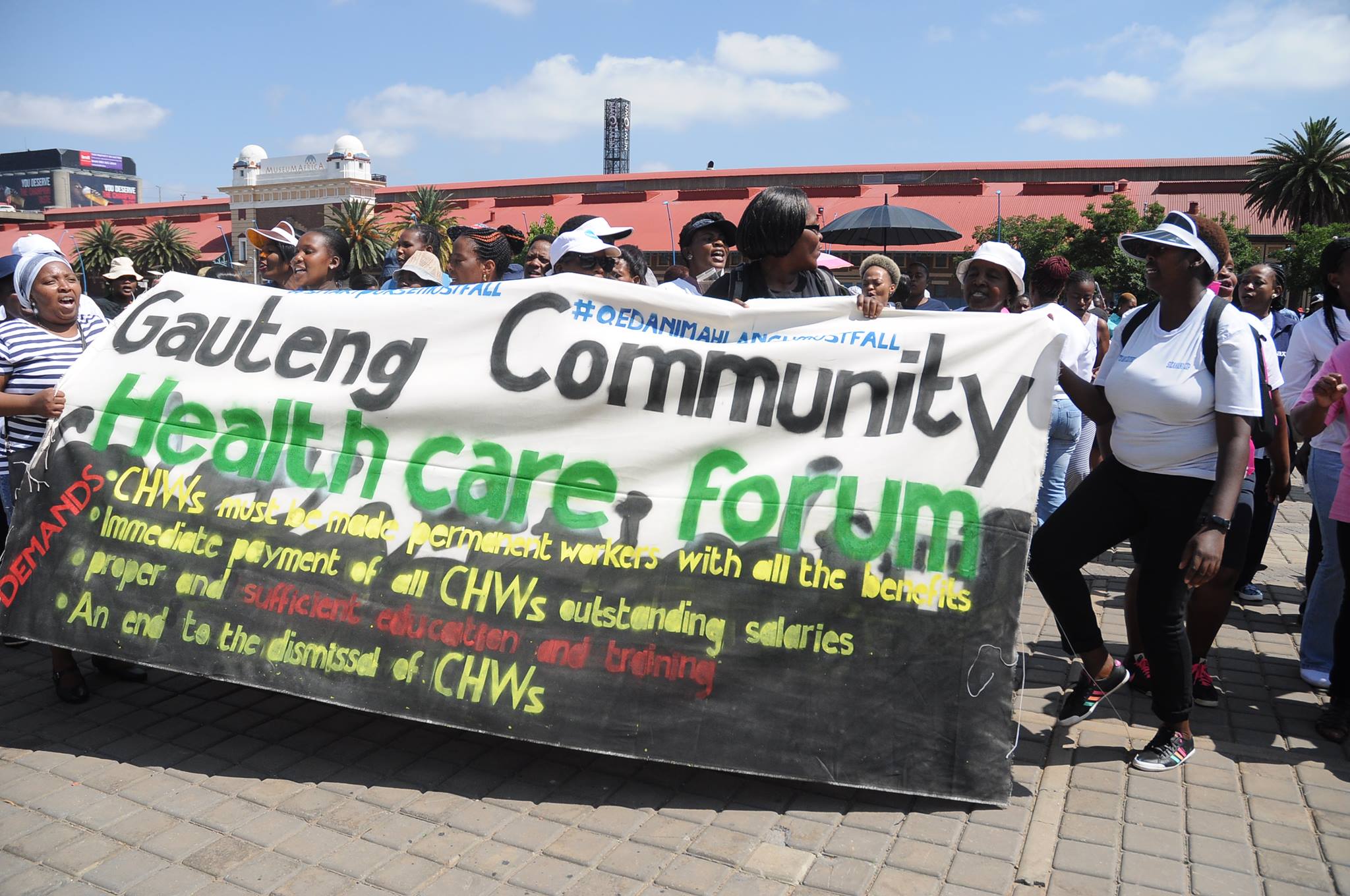
The problems facing Expanded Public Works Programme (EPWP) workers, Community Works Programme (CWP) workers and Community Health Workers (CHWs) EPWPs, CWPs and CHWs are doing permanent work – work that should be done and was once done by municipal workers and health workers. But their employment is not secure. It is short term and precarious. Also, they don’t get the same wages and benefits as the permanent public sector or local government workers. EPWPs are not even paid the very low national minimum wage of R28,79 per hour. They are only paid R15,63 per hour but are doing work of a permanent nature. When their services are terminated, EPWPs, CWPs and CHWs are not entitled to apply for Unemployment (UIF)! CWPs are the most precarious and insecure, and the cheapest form of employment. For instance, the CWPs in Kwakatsi in the Free State are only working two days in the week, 8 days in total for a month, and they are paid only R1000 per month. Many CWPs have been in this type of work for many years. And now, the government is even saying that people above 50 years should no longer be employed as CWPs. CHWs find themselves in the same cycle of precarious and insecure employment even though they are providing essential healthcare. The stipends that they received are extremely low and many times they are not even paid the stipend.
NEW ATTACKS ON WORKER RIGHTS BY THE GOVERNMENT, BOSSES AND SOME TRADE UNIONS
The South African government, bosses and some trade union federations (COSATU, FEDUSA, NACTU) have negotiated changes to the country’s labour laws. The proposed labour law changes are going to intensify the casualisation of work and increase the precarious and short term nature of employment. The proposed labour law changes are in line with the cheap labour policies of the SA government.
How are these labour law changes making labour more precarious and cheaper?
EASIER TO FIRE WORKERS
At the moment, before a worker can be dismissed an employer must provide reasons for the dismissal and hold a formal disciplinary hearing. The new changes allow the employer to dismiss a new worker during the first three months of employment without any reason and without a disciplinary hearing. What this means is that an employer can hire a new worker and fire that worker within the first three months of employment without giving any explanation for the dismissal and without giving the worker a chance to defend himself/herself. A new worker who is on probation for 3 months or longer can also be fired without any reason and without a disciplinary hearing.
The employers could employ young workers only to fire them within 3 months, hire more young workers and fire them too. New, young workers will have no job security and will not be able to plan for the future.
LOWERING THE WAGES OF WORKERS
The proposed labour law changes are attempting to cheapen the labour power of workers. Wage agreements negotiated in bargaining councils will no longer be binding on an employer of a new business that employs less than 50 employees and is in business for less than 2 years.
What does this mean?
If an employer opens a new metal factory, for instance, and employs 49 workers, this employer is not obliged for the first two years to pay the Metal Bargaining Council’s minimum wage of R63,14 per hour. During this two-year period the employer is only required to pay the workers the national minimum wage of R28,79 per hour, instead of the R63,14 per hour. The worker will lose R34,35 per hour, R1442.70 per week (for a 42-hour week) and R6 246.89 for the month from the change to the law.
THE AMENDMENTS ARE IN LINE WITH THE GOVERNMENT’S CHEAP BLACK LABOUR POLICIES
These changes are clearly aimed at making labour more precarious, insecure and cheap, which is in line with the cheap labour policies of the government. The EPWPs, CWPs and CHWs are all examples of these forms of cheap and precarious labour.
The changes to the labour laws are part of a broader attack on all workers. The government has already said it will not allow workers who are over 50 years old to be part of the CWP.
It has also cut the budget of the EPWP and CWP. This will mean even less employment and income for the unemployed.
This press statement was released by Simunye Workers Forum and Casual Workers Advice Office on 23 July 2025.


