
 Download PDF
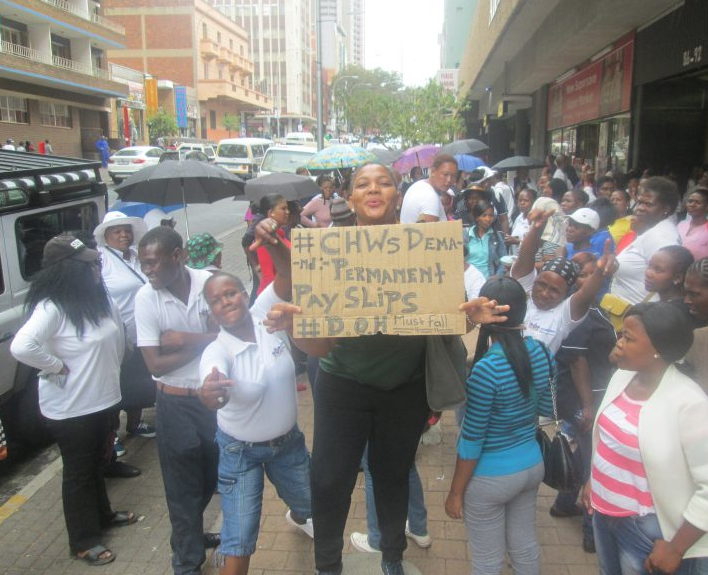
The recent outcome announced by the National Education, Health and Allied Workers Union (Nehawu) has created deep divisions among Community Health Workers (CHWs). What was meant to be a moment of progress has instead left many workers feeling confused, excluded, and betrayed. The biggest divide has formed between CHWs with matric and those without it, a painful split that has shaken teams who have worked side by side for decades.
Many of the CHWs most affected are those who joined the programme in the 1990s. These workers have carried the health system through difficult times, collecting statistics, tracing patients, supporting communities, and maintaining programmes long before CHWs were recognised as essential. Yet many of them do not have matric, and the Department of Health (DOH) has now introduced conditions that seem designed to sideline them.
What is most hurtful, CHWs say, is that some of those excluded have been loyal Nehawu members for years, paying subscriptions faithfully and standing with the union through every struggle. They cannot understand how the union could now support an agreement that only absorbs about 27,000 CHWs, especially when Nehawu’s own award once deemed all CHWs permanent.
Many feel betrayed that the union that claims to fight for the working class now appears to be leaving behind thousands of workers simply because of a matric certificate.
Adding to the confusion, Nehawu announced on its official Facebook page that the agreement marks a “new chapter for all CHWs in the country” as they sign for permanent employment. But CHWs on the ground know that South Africa has over 40,000 CHWs. The maths does not add up, and this contradiction has deepened mistrust.
CHWs describe it as painful to have started the programme together, suffered the same challenges, and built the same system, only to be separated at the final moment when conditions are finally improving. Many see the proposed R1,000 increment as a slap in the face, far from the kind of recognition they expected after years of service.
This frustration is not new. Since January 2025, CHWs across the North West province had been hearing reports that permanency was finally coming. At first, this brought excitement. CHWs believed that all of them would be absorbed; that the struggle was nearing its end. But as the months passed, the story kept changing.
The first date given for absorption was 1 September 2025. When nothing happened, the date shifted to 1 November. Still nothing. Uncertainty, disappointment, and lack of communication created tension in many facilities. CHWs say they are now struggling to unite, with disagreements and frustrations affecting their teamwork.
The issue of education has worsened the situation. CHWs without matric feel looked down upon, saying,
We can’t sit at the same place with them. We all work the same, and we all want to be permanent, not only the 27,000.
There is also concern for CHWs in their 60s. These workers have served communities for decades with dedication and heart. Now they are told they may have to retire before enjoying the benefits of permanency.
Younger CHWs feel it is unfair for the very people who carried the programme from the beginning to be left out at the end.
Those without matric have now been told they must rewrite it to be placed on the database of permanent CHWs. But many ask: what about workers who cannot read or write because they left school early due to poverty or family circumstances? These CHWs have been doing the work successfully for years, why are they suddenly considered unqualified?
By 1 December 2025, permanency still has not materialised, reportedly due to incomplete paperwork. This raises more questions:
Will back pay be included once absorption finally happens? Will the R1,000 increase continue every year for CHWs who are not absorbed? What will happen to those who remain on contract because they do not have matric? Will their contracts still be renewed annually? And the most painful question:
If a CHW without matric turns 60 before being absorbed, will she simply go home with nothing? Or will the department compensate her for a lifetime of service?
These uncertainties have left CHWs feeling anxious and demoralised. What should have been a celebration of progress has instead highlighted long-standing inequalities and divisions within the system. CHWs are calling for fairness, transparency, and dignity, for a solution that honours every worker who has contributed to the health of South Africa’s communities, regardless of age or qualification.
This article is an opinion piece submitted on 01 December 2025. The views expressed by the author do not necessarily reflect those of Karibu! Online or Khanya College. You may republish this article, so long as you credit the authors and Karibu! Online (www.Karibu.org.za), and do not change the text. Please include a link back to the original article.


