
 Download PDF
On 16 May 2026, Khanya College officially launched its 40th anniversary celebrations and the theme for the 18th Jozi Book Fair, ‘Education for Liberation – Going Back to Our Soweto Roots’. The launch brought together Khanya board members, comrades from allied organisations such as the International Labour Research and Information Group (ILRIG), Bench Marks Foundation, Orphan and Vulnerable Centres (OVCs) from Orlando, Lenasia, and Eldorado Park, learners from inner-city schools, former Khanya staff members, Community Health Workers, and out-of-school youth involved in Khanya College study groups.
The programme opened in a joyful atmosphere filled with music, dance and fun icebreakers. Khanya College board member Comrade Mondli Hlatshwayo officially welcomed participants and reflected on the historical conditions under which Khanya College was founded. Comrade Hlatshwayo reminded attendees that Khanya was established in 1986, two years after the 1984 Vaal Uprising, during a period of intense liberation struggles in South Africa.
The Khanya board member also spoke about the many challenges that Khanya College has faced over four decades, while emphasising the organisation’s resilience and continued commitment to education for liberation.
He explained that the launch marked the beginning of a series of activities planned for the 40th anniversary celebrations, which include the Khanya Winter School in June and the 18th Jozi Book Fair in October.
Khanya College Director, Comrade Maria van Driel, officially launched the Jozi Book Fair theme, ‘Education for Liberation, going back to our Soweto roots.’ Comrade van Driel explained that the theme is linked to both the 40 years of Khanya College’s work in political education and the 50th anniversary of the 1976 Soweto Uprising.
Reflecting on the student struggles of 1976, the Khanya director reminded participants that the demand for quality education remains urgent today. Comrade van Driel stressed that the Jozi Book Fair continues this legacy by using books as tools to reclaim knowledge and deepen understanding of the world.
The launch also featured an international solidarity message from activist, novelist and Jozi Book Fair patron Comrade Lindsey Collen. In a recorded video message, Comrade Collen spoke about the experiences of prisoners on Robben Island, explaining how political prisoners organised themselves to teach each other reading and writing skills.
She highlighted how education and collective learning strengthened the struggle for liberation. Comrade Collen stated that, “when you embark on the struggle for liberation, that itself is liberation.”
She also reflected on the Palestinian struggle, saying that just as people across the world supported South Africans during apartheid, there is a responsibility today to support Palestinians in their struggle for freedom.
Explaining the meaning of “Education for Liberation,” Comrade Collen said: “We liberate ourselves and help others in the struggle to liberate themselves.”
Former Jozi Book Fair short story competition winners and former Khanya study group participants also shared their experiences. Belita Andre, who joined Khanya programmes in 2016 while still in high school, spoke about the role played by comrades such as Comrade Keorapetse Kgositsile in shaping young artists and activists. Andre described how Khanya’s monthly workshops and performances helped develop writing skills and political consciousness among young people.
Nyeleti Mbatha, now a university student in Port Elizabeth, reflected on her involvement in Tsohang Batjha (TB) and Khanya study groups, describing the importance of growing up surrounded by books and reading groups. Makhosazana Aphane, currently studying in the Western Cape, spoke about how the study groups taught participants about the Constitution, human rights, and the importance of standing against social injustice through writing and activism.
Khanya College Programme Coordinator, Comrade Nosipho Mdletshe, introduced books that will be read this year, including Mutiny by Lindsey Collen, Critical but Stable by Angela Makholwa, Woman at Point Zero by Nawal El Saadawi, and Thoko’s First Library Book by Niki Daly. These books were presented as important tools for political education, reflection and critical discussion.
Music and poetry formed an important part of the programme, reflecting the themes of liberation, solidarity, land and social justice. Songs included Imagine by John Lennon, Ain’t Got No, I Got Life by Nina Simone, and Miriam Makeba’s A Piece of Ground. Amahle Ndlovu, a learner from the Tsohang Batjha study groups, read Warsan Shire’s poem Home, highlighting themes of refugee experiences, solidarity and opposition to xenophobia.
Photographer and activist Comrade Jimmy Matthews also joined the event on Zoom, speaking about forced removals and drawing comparisons between Palestine and District Six through his photographic work. Comrade Matthews reflected on the 78th anniversary of the Nakba and the ongoing similarities between apartheid-era forced removals and the displacement experienced by Palestinians today.
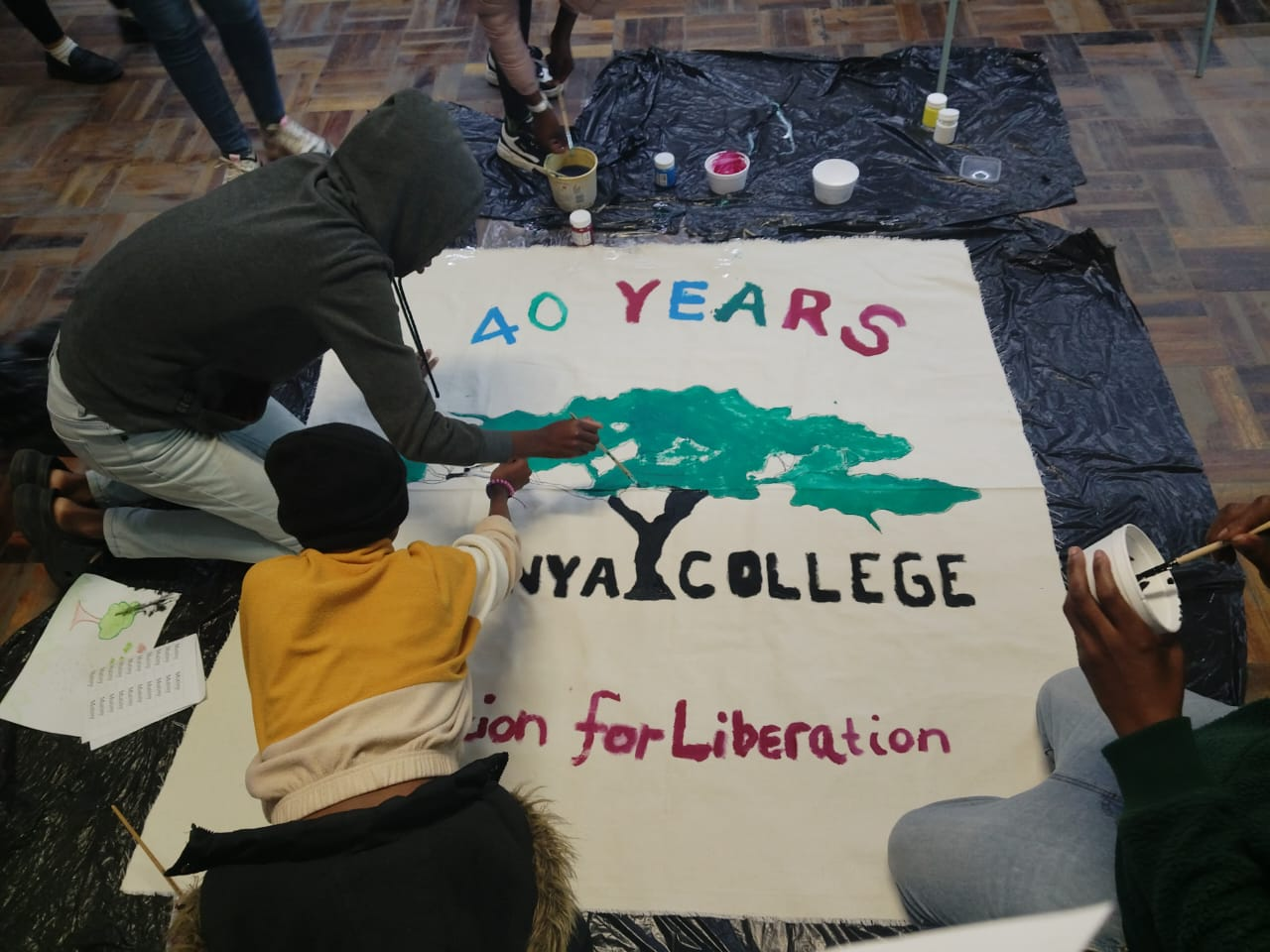
The event concluded with an art session where participants collectively painted banners representing what “Education for Liberation” means to them. The reflective session encouraged creativity while allowing participants to celebrate the impact of Khanya College over the past 40 years and to imagine a future rooted in solidarity, education, and liberation.
This article was submitted on 25 May 2026. You may republish this article, so long as you credit the authors and Karibu! Online (www.Karibu.org.za), and do not change the text. Please include a link back to the original article.

