
 Download PDF
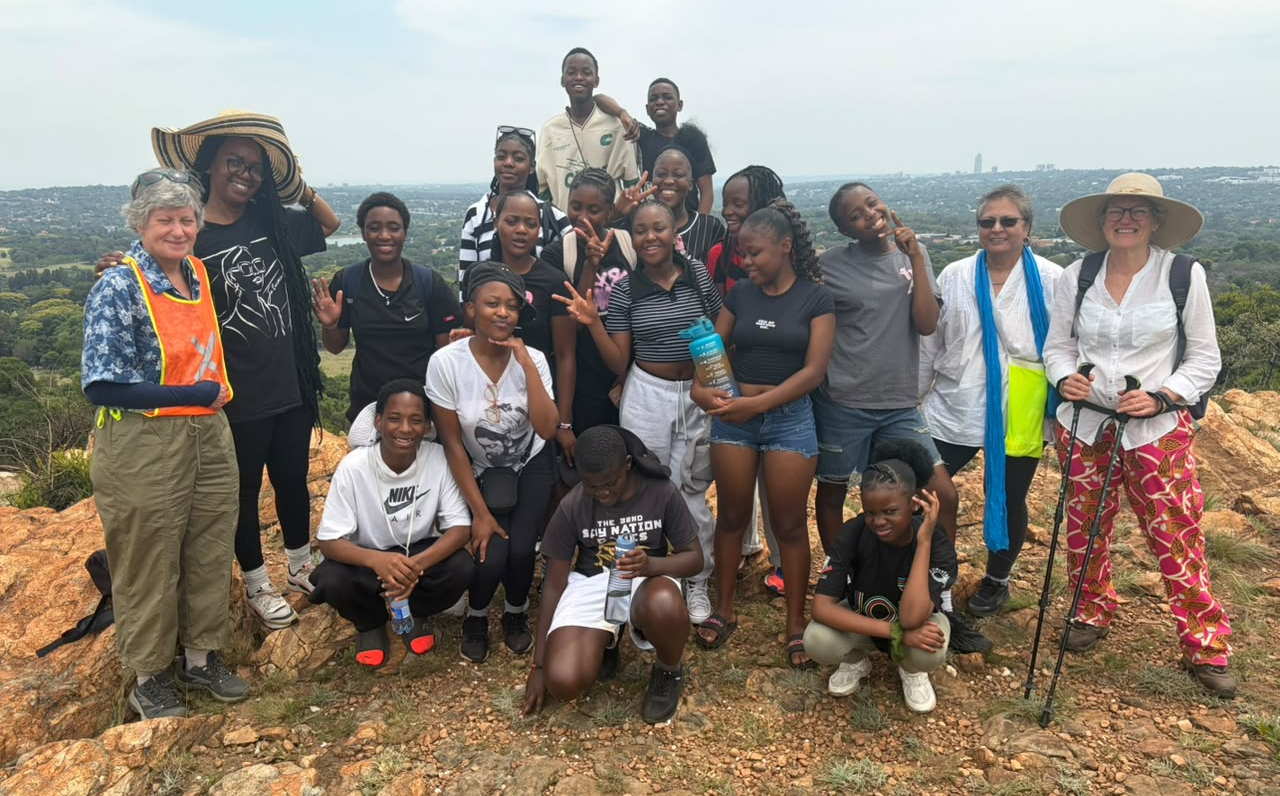
Tsohang Batjha (TB) short story competition winners learn about the knowledge, survival skills, and relationship with nature of their ancestors during a guided tour led by Jenny Grice, the guide who is also the chairperson of the Melville Koppies. On 14 November 2026, the TBs met Khanya staff at the Workers Museum, where they reflected on their experiences.
The guided tour allowed the participants to explore nature, learn about different plant and animal species, and reflect on how their ancestors lived and survived. The visit also raised questions about heritage, belonging and access to natural spaces.
During the trip, the TBs learnt about the San people and other early communities around Melville, including their use of plants, herbs, rocks and trees for food, medicine, shelter, clothing and making tools.
Andile Ncube reflected on how their ancestors used plants and herbs for medicinal purposes. She also learnt how the San used rocks and plants for hunting and cowhide to make clothing.
She said she was particularly interested in learning about anthills and how termite colonies function.
Amkelo Ngobese described the hiking experience as great and said she had learnt important information about how their ancestors survived. Ngobese highlighted how particular types of vegetation were used to treat illnesses.
Owale Lutshinda also spoke about the resourcefulness of ancient communities, particularly how they made use of different rocks and tree bark. Lutshinda emphasised the importance of preserving nature and understanding the environment, including the migration of birds in search of food. She also noted that people should not kill insects unnecessarily.
Participants also learnt about different bird species and their behaviour. Kholeka Khumalo spoke about the different types of birds they encountered, including cuckoos, and learnt about the umbrella tree, which hunter-gatherers used for shelter.
Noxolo Masuku explained that cuckoo birds lay their eggs in the nests of other birds. She told the diners that she also learnt about the properties of the umbrella tree, whose soft interior can absorb large amounts of water.
Zinhle Dabangana reflected on the importance of understanding animal behaviour rather than relying on superstition. She said seeing owls should not automatically be associated with witchcraft, as owls are also birds that hunt for food.
Bongiwe Ngwenya enjoyed learning about termites and their colonies, drawing comparisons between insect societies and human society. She also appreciated learning about bird calls and the views from the koppies.
Other TBs shared their enjoyment of the hiking experience and the opportunity to learn outside their usual environments.
Ayanda said climbing to the top was her favourite part of the trip, while Lamola Happy reflected on how ancient communities hunted for food and understood which trees were dangerous. Rui Mathe’s contribution also highlighted the importance of learning about the different species found in the area.
Beyond the natural environment, the trip prompted discussions about history, identity and people’s relationship with their heritage.
Khanya Projects Coordinator Nosipho Mdletshe described the experience as bittersweet. While she appreciated the opportunity to learn, it also made her realise how little exposure many people have to these natural and historical spaces. She reflected that many township residents do not have similar opportunities to engage with these places and experiences, which can feel reserved for certain sections of society.
Khanya Director, Comrade Maria Van Driel, raised during the discussion was the relationship between historical periods and identity, including the histories of the San, Khoekhoe and Sotho-Tswana communities. Participants were encouraged to think about their connections to these histories and the knowledge passed down through generations.
The discussion drew a connection between looking back thousands of years, including the history of people living around 50,000 years ago, and remembering more recent history. One reflection questioned how people could engage with ancient history while forgetting significant events such as the 1976 Soweto Uprising, whose 50th anniversary is being commemorated in 2026.
The Melville Koppies trip was therefore more than a hiking experience. It provided an opportunity to learn about nature, ancient knowledge and survival, while encouraging participants to reflect on their own histories, sense of belonging and relationship with the environment.
This article was submitted on 17 September 2026. You may republish this article, so long as you credit the authors and Karibu! Online (www.Karibu.org.za), and do not change the text. Please include a link back to the original article.

