
 Download PDF
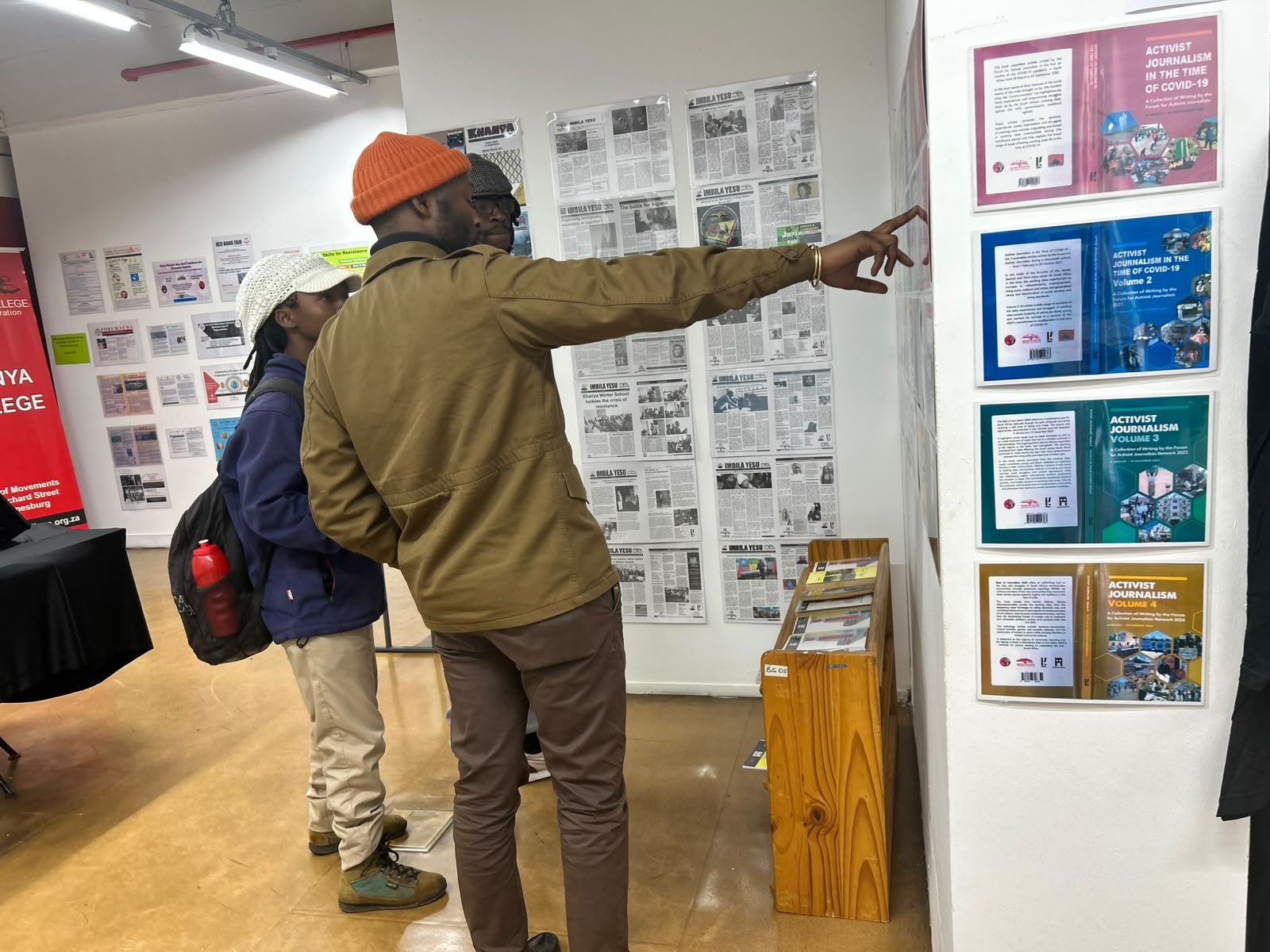
Part of the Khanya College 40th anniversary celebrations came in the form of two exhibitions mounted at Museum Africa in Newtown, Johannesburg and which will last for the duration of October 2026.
The exhibitions tell two different but connected stories. The first, “I was, I am, I will be!”, looks at Khanya College’s work, changing over the last four decades through the publications it has produced. This forms a part of its education, including t-shirts, research, and movement-building work. The second, “From District Six to Palestine”, is a photographic exhibition by veteran photographer and journalist Jimi Matthews, curated for Khanya College, which brings together photographs of the forced removals and destruction of District Six with photographs of Palestinian life, displacement and resistance against Zionist oppression and ethnic cleansing.
Both exhibitions speak to Khanya’s long-standing emphasis on education, memory, history and solidarity, needed for the coterminous three moments necessary for social change to truly occur.
The struggle for a free Palestine has also become an important part of Khanya College’s political education and solidarity work. Over the years, the College has hosted discussions involving Palestinian activists and South African formations supporting Palestinian liberation. These engagements have helped provide crucial insight into the Palestinian struggle and experience.
Using popular education, Khanya-associated theatre group, Page Turner Infotainment has also dramatised the Palestinian struggle. The performance was Resist My People, Resist Them, a title inspired by Palestinian poet Dareen Tatour.
A dramatic performance depicting life under bombardment in Palestine brought the experiences of loss, grief, and displacement to the stage.
The play depicts the events following 7 October 2023 and is focused on a Palestinian family living through repeated bombing and destruction. Through poetic narration and dramatic scenes, it portrays a landscape where homes have been reduced to rubble and ordinary life has been disrupted by violence.
One of the central scenes depicts a father searching through the remains of a destroyed building after his daughter and three grandchildren are killed. The character, who works rescuing people from collapsed buildings, is forced to recover his own family from the rubble and later bury them himself.
The performance highlights the emotional toll of loss while facing the destruction of civilian homes. Following the depiction of grief, the play calls for resistance, portraying Palestinians as continuing to struggle for freedom despite the destruction around them.
The play ultimately presents Palestinian resistance as a response to dispossession, violence and the loss of home and family.
For its 40th anniversary, Khanya used the exhibitions to connect its own history of education and organising with broader struggles for liberation and social justice.
“I was, I am, I will be!”
The first exhibition opened on 1 October 2026, on the first day of the Khanya College 40th Anniversary Conference.
The exhibition brings together publications produced by Khanya College and its programmes over the years. Publications have been an important part of the College’s work, ranging from books and research publications to newsletters, manuals, posters and other popular educational materials. Khanya has always said that its publications are intended to make ideas accessible while also introducing readers to deeper political and theoretical debates. This work is also done through study groups organised by the college.
Among the publications displayed are titles such as Ufil’umuntu, Ufil’usadikiza, which reflects the importance of memory and legacy in the organisation’s work. The exhibition provides visitors with an opportunity to see how Khanya has used writing and publishing as tools for political education and organising.
The College’s publication history also includes Tsohang Batjha, Ditokelo and My Class, among other publications produced for different constituencies. To consolidate its publishing work, Khanya Publishing, was established by Khanya in 2009.
Therefore, the exhibition shows part of the intellectual and political history of an organisation that has worked for 40 years to create spaces for working class communities to learn, discuss and organise. Importantly, many of the publications displayed show important and organic, grassroots contributions by working class activists and writers, many of whom were trained at Khanya.
“From District Six to Palestine”
The second exhibition, “From District Six to Palestine”, debuted on 2 October 2026.
Jimi Matthews’ photographs bring together two periods separated by decades. His photographs of District Six document the destruction of the Cape Town community under apartheid-era forced removals. District Six was declared a white area in 1966, and more than 60,000 people were eventually removed from the area. Matthews photographed the demolition and the changing landscape as it happened.
The Palestine photographs come from a later period in Matthews’ career. In 2023, he travelled through the occupied West Bank, photographing Palestinian people, streets, markets and everyday life alongside the physical signs of occupation and displacement. Some of this work also appeared in his exhibition Existence is Resistance.
By placing the photographs together, Matthews draws attention to the relationship between land, displacement, identity and memory. The exhibition challenges viewers to consider what happens to communities when people are removed from the places where they have lived and built their lives.
There is also a contrast between the two bodies of work. In many of the District Six photographs, people have already disappeared from the landscape, leaving behind demolished buildings and empty spaces. In the Palestinian photographs, Matthews often places people at the centre of the frame, showing everyday life alongside the conditions of occupation.
For Khanya College, the exhibition provides another way of connecting South Africa’s history of apartheid and forced removals with the ongoing struggle for Palestinian liberation.
The two exhibitions therefore form an important part of Khanya College’s 40th anniversary celebrations. One looks inward at four decades of education, publishing and movement building; the other looks outward, connecting South African memories of forced removal with Palestinian struggles over land, home, identity and freedom.
Together, they reinforce the anniversary theme of education for liberation and Khanya’s belief that history should not only be remembered, but used to understand the struggles of the present and imagine a different future.
This article was submitted on 08 October 2026. You may republish this article, so long as you credit the authors and Karibu! Online (www.Karibu.org.za), and do not change the text. Please include a link back to the original article.


