
 Download PDF
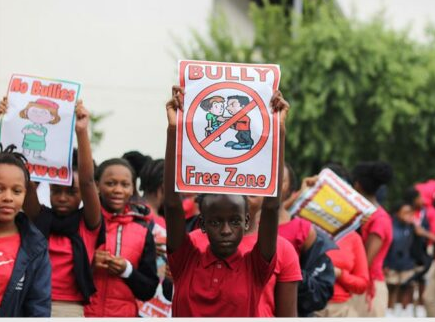
Bullying takes place in many different forms. Many forms of bullying are not easy to recognise for some people.
Most people mainly think of bullying as just basic name-calling, pushing, touching, or beating someone up.
Sometimes bullying starts with threats, spreading rumours, or even making sexual comments about someone, effectively a case of harassment.
Bullying doesn’t only affect certain kinds of people, but it could be anyone — boys, girls, women, men, and LGBTQ+ people. It happens all over, in schools and public places. Anti-LGBTQ+-related insults, jokes, and behaviour are not only directed at LGBTQ+ people but sometimes form the basis of insults to any victim, especially boys and men.
In workplaces such as schools, bullying can occur between teachers and learners. At times, it is the learners who bully the teachers. In areas such as Eldorado Park, in Soweto, some learners are bullied because of their skin colour or even the type of hair they have. Working in these schools and with community activists embedded in these communities, Karibu learned that it is common for bullying to be gendered and thus it affects many people directly and indirectly. As a result, many learners end up dropping out of school. This is also because of fear of being humiliated by school bullies who sometimes double up as gang members. Bullying creates many cases of mental health problems and breaks the victim’s feelings of self-worth.
One of the classic forms of bullying is body shaming and name-calling directed against women and girls. “It breaks your spirit and makes you question yourself. It makes us feel depressed, and we would rather keep silent. When we report the bullying, the police don’t do anything,” says one of the victims of bullying at Missouri Secondary School, preferring to stay anonymous.
“Report bullying even if you are scared. It could save your life and someone else’s life.”
At school, at the workplace, and in the community, everyone should be safe.
“When someone spreads lies about you, it makes you feel alone. It might be at school, someone taking your lunch money, touching you without your permission, or someone smacking you for something that belongs to you,” continues the learner.
Victims should tell someone that they trust. There’s always someone trustworthy enough to help the victim, sometimes this is an official at a dedicated organisation.
Victims should never let anyone take their power by breaking their self-esteem.
This article is an opinion piece submitted on 14 August 2026. The views expressed by the author do not necessarily reflect those of Karibu! Online or Khanya College. You may republish this article, so long as you credit the authors and Karibu! Online (www.Karibu.org.za), and do not change the text. Please include a link back to the original article.

-
Anjanet Esau
-
Anjanet Esau

-
Karibu! Staff
-
Karibu! Staff
-
Karibu! Staff
-
Karibu! Staff
-
Karibu! Staff
-
Karibu! Staff
-
Karibu! Staff
-
Karibu! Staff
-
Karibu! Staff
-
Karibu! Staff
-
Karibu! Staff
-
Karibu! Staff
-
Karibu! Staff
-
Karibu! Staff
-
Karibu! Staff
-
Karibu! Staff
-
Karibu! Staff
-
Karibu! Staff
-
Karibu! Staff
-
Karibu! Staff
-
Karibu! Staff
-
Karibu! Staff
-
Karibu! Staff
-
Karibu! Staff
-
Karibu! Staff
-
Karibu! Staff
-
Karibu! Staff
-
Karibu! Staff
-
Karibu! Staff
-
Karibu! Staff
-
Karibu! Staff
-
Karibu! Staff
-
Karibu! Staff
-
Karibu! Staff
-
Karibu! Staff
-
Karibu! Staff
-
Karibu! Staff
-
Karibu! Staff
-
Karibu! Staff
-
Karibu! Staff
-
Karibu! Staff
-
Karibu! Staff
-
Karibu! Staff
-
Karibu! Staff
-
Karibu! Staff
-
Karibu! Staff

