
 Download PDF
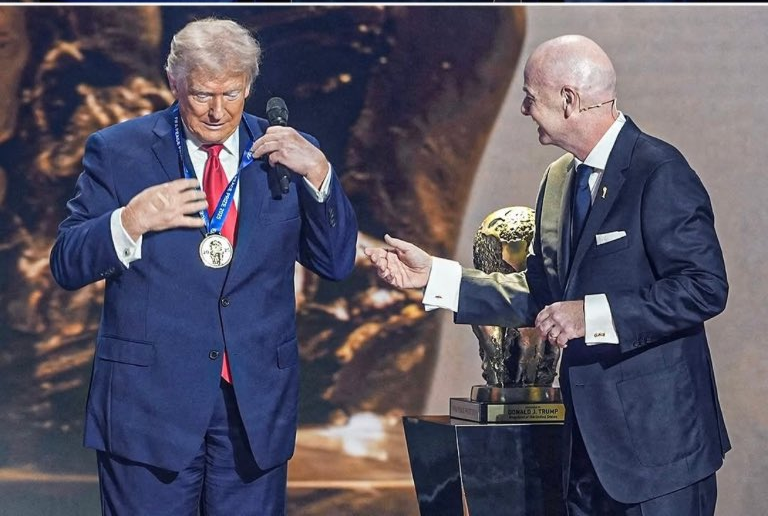
On 5 December 2025, the International Federation of Football Associations (FIFA) announced US President Donald Trump as the recipient of the inaugural peace award under its organisation, the FIFA Peace Prize, at the draw ceremony for the 2026 FIFA World Cup in Washington, D.C. Trump has now collected two peace-type honours in the same year, the other being the Richard Nixon Foundation’s Architect of Peace Award. The symbolism is striking: two major institutions, both historically entangled in political controversy, choosing a figure as polarising as Trump to inaugurate their respective peace accolades.
Is Trump a champion of peace? The answer remains an uncomplicated no. While the President of the most powerful nation on earth regularly urges Ukrainian President Volodymyr Zelensky to “make a deal” with Russia’s Vladimir Putin, these demands do not, on their own, elevate him to the status of peacemaker. If anything, they expose a transactional worldview: peace where convenient, aggression where profitable. Those observing from Gaza will remember that Trump has been one of the most enthusiastic backers of Israel’s military operations since the war erupted in October 2023. Far from tempering Prime Minister Benjamin Netanyahu’s campaign, Trump has provided rhetorical and diplomatic cover, joining a long line of US presidents who have defended Israel irrespective of human rights violations.
Israel has faced more United Nations resolutions than all other countries combined, yet the United States has repeatedly wielded its veto in the UN Security Council to shield Israel from accountability. This includes blocking resolutions concerning the war in Gaza, many of them aimed at protecting civilians. Trump is therefore not a peacemaker but a warmonger who occasionally utters the word “peace” when it serves Washington’s geopolitical interests. It is no wonder that Netanyahu once called for Trump to receive the Nobel Peace Prize. In the Israeli leader’s view, Trump is “deserving”, a telling endorsement given the circumstances.
Recently, Trump has also threatened Venezuela with military action. His justification centres on alleged drug cartel activity, but such claims conveniently bypass diplomatic or law-enforcement-based solutions. Instead, he leaps directly to the language of armed confrontation, signalling once again that military force is his preferred instrument of foreign policy. It is difficult to reconcile this record with any coherent definition of peace leadership.
His posture toward South Africa offers another revealing example. Trump has lent support to the long-debunked assertion that white South Africans face genocide, a fabrication circulated by fringe groups but lacking any legitimate evidentiary basis. Peace awards, in theory, are reserved for individuals who strive not only to prevent conflict but also to promote unity, truth and social cohesion. Yet the first ever recipient of the FIFA Peace Prize has repeatedly amplified falsehoods that sow division within South Africa and deepen racial tensions.
These contradictions make FIFA’s decision puzzling unless one accepts that the award was not designed to celebrate genuine peacebuilding. FIFA itself is hardly an institution free of political manoeuvring. Its decisions on geopolitical matters have long reflected diplomatic pressures and selective ethics. Consider, for instance, the contrast between its responses to Russia and Israel. When Russia launched its full-scale invasion of Ukraine in 2022, FIFA rapidly expelled Russian teams from international football. Yet when Israel began its bombardment of Gaza the following year, resulting in the deaths of thousands of civilians, including women and children, FIFA issued no sanctions, no suspensions, and no meaningful condemnation. The inconsistency is glaring: accountability for some, indulgence for others, depending largely on Western alliances.
Seen in this light, the FIFA Peace Prize is less a recognition of moral achievement and more a symbolic gesture wrapped in sporting theatrics. Peace-type awards often function in this way. Many exist not to honour genuine champions of non-violence but to reinforce political narratives favoured by Western powers or influential institutions. This is why it is unsurprising to find past recipients of peace laureates who themselves oversaw conflict. Shimon Peres, awarded the Nobel Peace Prize in 1994, was simultaneously implicated in policies that entrenched occupation and expanded military engagement against Palestinians. Henry Kissinger, joint laureate in 1973, remains one of the most controversial figures in US foreign policy; his tenure oversaw covert bombings in Cambodia, support for dictatorships in Latin America and complicity in mass atrocities.
Such examples illuminate the broader issue, peace awards are often deployed as political instruments. They help launder reputations, elevate favoured leaders and rewrite history in real time. Trump’s awards fit neatly into this pattern. They allow supporters to claim moral high ground while ignoring the consequences of his policies, from Gaza to Caracas to Pretoria. They also demonstrate how institutions, desperate to appear relevant or aligned with dominant geopolitical forces, become complicit in the myth-making of powerful figures.
None of this is to say that peace prizes cannot serve meaningful purposes. Some do recognise grassroots activists, human rights defenders and community leaders whose work is genuinely transformative. But the inflation of peace awards, many created without rigorous criteria, independent oversight or meaningful accountability, has diluted their significance. In this context, Trump’s honours are emblematic of a wider erosion of moral clarity in global politics. When a leader whose actions repeatedly undermine peace can be crowned as a peacemaker, it becomes clear that these awards reveal more about the institutions bestowing them than about the recipients themselves.
In the end, Trump’s peace prizes are not about Trump at all. They are reflections of the political structures that elevate power over principle, spectacle over substance, and symbolism over justice. They remind us that the language of peace can be easily co-opted, twisted and repackaged, even by those who wage war.
This article is an opinion piece submitted on 12 December 2025. The views expressed by the author do not necessarily reflect those of Karibu! Online or Khanya College. You may republish this article, so long as you credit the authors and Karibu! Online (www.Karibu.org.za), and do not change the text. Please include a link back to the original article.

