
 Download PDF
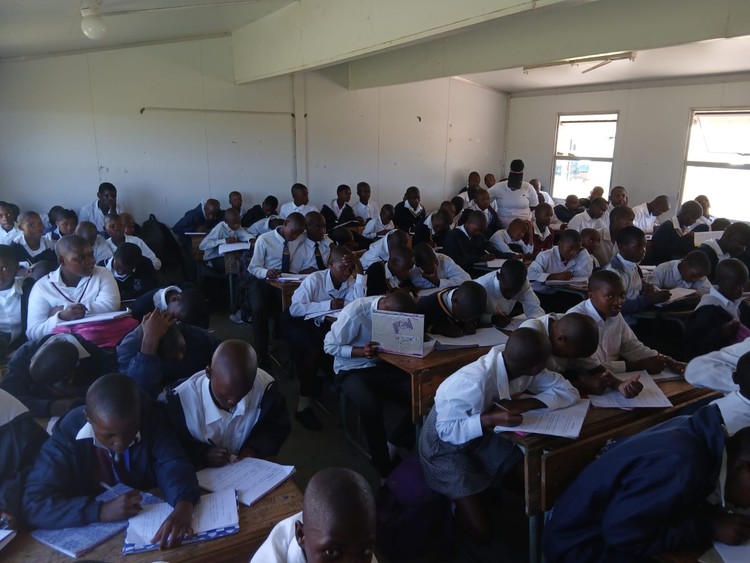
On 28 April 2026 during a press briefing, Gauteng Education MEC Lebohang Maile said the province needed 200 new schools. He highlighted that almost half of Gauteng’s 2,111 public schools are overcrowded. In some classrooms, there are about 70 learners and only one teacher.
MEC Maile said that school enrolment increases every year, and overcrowding changes everything inside the classroom because classrooms become disruptive and teachers cannot attend to all learners.
Karibu spoke to some educators and learners to find out how the shortage of schools in some areas of Gauteng affects them.
“I really want to help each learner, but I can’t get to everyone. If I stop to help one child, maybe who cannot read, the rest start talking or fall behind. So most days I just push on with the lesson,” says Ms Judith Moeti, who teaches Grade 7 at a Johannesburg school.
For some learners, that means they sit there feeling left out. For others, it’s a chance to be disruptive while the teacher is busy.
In an overcrowded class many children are too scared to read out loud, especially if they are struggling. Some pretend they are fine so that no one laughs at them.
A 13-year-old boy said “If I don’t know the answer, I don’t put my hand up and I won’t read out aloud either. If I get it wrong, the other classmates laugh. I just keep quiet and copy from the girl next to me.”
The ones who can read sometimes end up helping their friends, which can be stressful too. Even the learners who can read the words often don’t really understand what it means, and in a full classroom, that is easy to miss.
Mr Shane, an educator from Tembisa, added, “Overcrowded classrooms are unmanageable, but as teachers, we try our best to do our job. It’s not easy to spot learners’ barriers, though. Some learners are active and take part in class discussions, but when it comes to written activities, they can’t put down on paper what they have understood.”
“During home language periods, learners split up and go to their vernacular classes, then come back when it’s done. I guess during the vernacular period it’s more manageable, because only the learners who speak that home language is in that classroom,” said Ms Fakazi Zulu who teaches in the Tshwane district.
That’s why literacy matters; it’s not only about reading the words on a page, but also about understanding what you read so you can follow instructions in your school subjects and in real life. If a child hasn’t learned that by Grade 4, everything else becomes a struggle. Overcrowding only makes it harder when a child doesn’t understand. Learners stop trying and when a teacher cares but has 30-plus learners to attend to, they end up exhausted. When this happens, some learners just slip through the cracks without anyone noticing.
The MEC admits that the 200 new schools won’t be built overnight. However, every child deserves to learn and to be heard, even if the class is packed. We might not be able to make classes smaller today, but we can make sure children don’t lose their voice while they wait. The Jozi Book Fair is proof that even small efforts can start to change things.
Projects like the Jozi Book Fair (JBF) are stepping in as they bring books, literacy sessions, and social justice awareness campaigns into communities and schools. With the JBF, children and youth have a place where they can read, write, ask questions, and actually enjoy, without 70 other voices around them. Parents and other teachers start to see that reading doesn’t have to feel so hard, and that it can be fun.
This article was submitted on 28 April 2026. You may republish this article, so long as you credit the authors and Karibu! Online (www.Karibu.org.za), and do not change the text. Please include a link back to the original article.

